
TNEB Net Metering Guide 2025 - How to Get Zero Electricity Bills
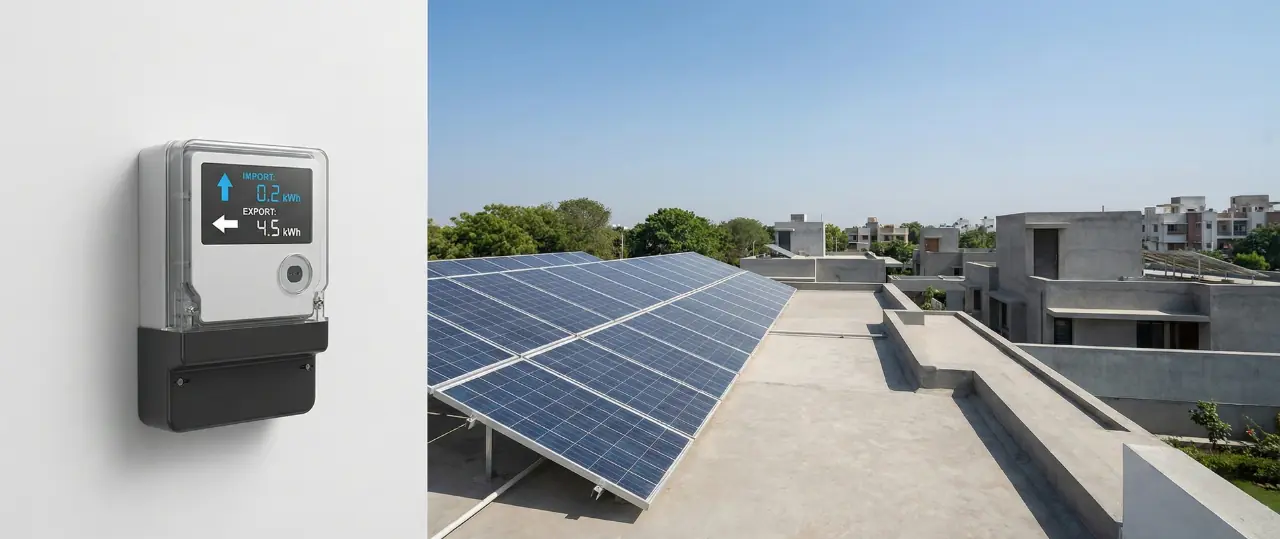
For most homeowners, the primary reason to install solar is to cut down on electricity bills. The mechanism that makes this possible is called Net-Metering. It allows you to "store" your excess solar power in the grid and use it when needed, effectively turning the electricity grid into a giant battery for your home.
However, the rules and processes for net-metering differ between Tamil Nadu (TNEB) and Puducherry (PED). With 2025 bringing new policy updates, it's crucial to understand how the system works to maximize your savings.
At Surya’s Solar, we don't just install panels; we handle the entire net-metering application, documentation, and approval process for our customers in Cuddalore, Panruti, Neyveli, and Puducherry. This guide explains everything from how the meter works to billing calculations and common pitfalls to avoid.
What Is Net-Metering? (Simple Explanation)
Think of net-metering as a banking system for electricity. It tracks the energy you produce versus the energy you consume.
- Generation: Your solar panels generate DC electricity during the day.
- Conversion: Your inverter converts this to AC power for your home.
- Consumption: Your home appliances (lights, fans, fridge) use this solar power first. This is "free" power that doesn't even touch the meter.
- Export: If your ACs are off and you're generating more than you need, the extra electricity flows back to the government grid.
- Import: At night, when solar isn't working, you draw power from the grid as usual.
- Billing: The "Net Meter" records both Import and Export. Your bill is based on the Net Consumption (Import - Export).
How Net-Metering Works in Tamil Nadu (TN-Specific)
The process in Tamil Nadu is straightforward but requires strict adherence to TANGEDCO guidelines.
The Flow of Power
- Daytime (8 AM - 4 PM): Your solar system is active. If you generate 15 units but only use 5 units, the remaining 10 units are exported to the TNEB grid.
- Nighttime (6 PM - 6 AM): Your solar system is off. You import power from the grid to run your lights and ACs.
- Billing Cycle: At the end of the billing period (usually bi-monthly in TN), TNEB calculates the difference.
The Calculation Formula
Billable Units = (Total Import Units) - (Total Export Units)
Example Scenario:
- Import (from TNEB): 500 units (mostly at night).
- Export (to TNEB): 450 units (during the day).
- Net Billable Units: 500 - 450 = 50 Units.
- Result: You only pay for 50 units!
If you export more than you import (e.g., Export 600, Import 500), the extra 100 units are carried forward as a credit to your next bill.
How Net-Metering Works in Puducherry (PED-Specific)
In Puducherry, the Electricity Department (PED) manages the grid. The core principle is the same, but there are local advantages.
- Faster Processing: Approvals in Puducherry are generally faster than in TN, often completed within 2-3 weeks.
- High Generation: Coastal houses in Pondicherry receive intense sunlight, leading to higher export units.
- Inverter Rules: PED is supportive of hybrid inverters, which is great for residents who want battery backup during occasional power cuts.
Residents in Pondicherry can significantly benefit from this, especially given the rising cooling needs in the coastal humidity.
Types of Meters Used (2025 Update)
The technology is evolving. Here are the meters you might see installed in your home.
a) Bi-Directional Meter (The Standard)
This is the most common digital meter installed for solar homes.
- Display: It cycles through different readings: Date, Time, Import (kWh), and Export (kWh).
- Function: It replaces your old unidirectional meter.
b) Smart Meter (New Rollout)
These are being rolled out in select areas of Tamil Nadu.
- Feature: They send real-time data to the DISCOM.
- Benefit: You can track your exact usage via a mobile app, eliminating billing errors.
c) Gross Metering (Commercial Only)
In this system, all solar power is exported to the grid, and you import all your needs. You are paid a fixed rate for generation.
- Verdict: This is rare for homes and mostly used for large commercial setups or educational institutions.
Net-Metering Eligibility (TN + Puducherry)
Before applying, check if you qualify.
Tamil Nadu (TNEB)
- System Size: Minimum 1 kW, Maximum 10 kW for residential (LT).
- Connection: Single-phase or 3-phase service connection.
- Inverter: Must be grid-tied or hybrid with anti-islanding protection (automatically shuts off during power cuts).
- Vendor: Must be installed by a DISCOM-approved vendor like Surya’s Solar.
Puducherry (PED)
- Property: Individual house with a valid domestic connection.
- Capacity: Up to 100% of your sanctioned load is allowed.
- Inverter: Hybrid inverters are allowed and encouraged due to power cuts.
Application Process (Step-by-Step)
We handle this headache for you, but here is the checklist so you know what happens.
- Rooftop Inspection: We verify structural stability and ensure you have a shadow-free area.
- Online Application: We submit the application to the TANGEDCO or PED portal with your consumer number.
- Document Submission: Aadhaar, Electricity Bill, Property Tax receipt.
- Feasibility Approval: The Assistant Engineer (AE) visits to check the transformer capacity and approves the technical feasibility.
- Installation: We install the solar system as per MNRE standards (DCR panels, proper earthing).
- Technical Inspection: TNEB/PED officials inspect the safety and quality of the installation.
- Meter Installation: You pay the meter fees. The old meter is removed, and the new Net Meter is installed and sealed.
- Activation: The system is switched on, and your savings begin immediately!
Calculate Your Solar Savings With Net-Metering
Our solar calculator shows how many units you can offset each month using net-metering.
Solar Savings Calculator Tamil Nadu
Calculate your potential savings with precision
Enter amount between ₹2,000 and ₹30,000 • We specialize in 3 kW+ systems
Net-Metering Charges & Billing Rules (2025)
There are some costs involved in the setup that you should budget for.
- TN Charges: You need to pay for the Net Meter itself (approx ₹3,000 - ₹5,000) and a one-time testing fee to TNEB.
- Puducherry Charges: Minimal application fees.
- Billing Cycle: Your bill remains monthly or bi-monthly as per your existing cycle.
- Carry Forward: If you have excess credit, it carries forward for 12 months. At the end of the financial year, some DISCOMs may settle this at a nominal rate, but the primary goal is self-consumption.
Example Bill Calculations
Let's see the real math for two typical scenarios.
Example A: 3 kW System in Cuddalore (TN)
- Total Consumption: 400 units (2 months)
- Solar Generation (Self-used): 150 units
- Solar Exported: 200 units
- Grid Import: 250 units
- Net Bill: 250 (Import) - 200 (Export) = 50 Units.
- Result: You pay for only 50 units! The bill drops from approx ₹2,000 to just ₹150 (fixed charges).
Example B: 5 kW System in Pondy
- Grid Import: 220 units
- Solar Export: 240 units
- Net Bill: 220 - 240 = -20 Units.
- Result: Zero Bill + 20 units credit carried forward to the next month.
Differences: Tamil Nadu vs Puducherry Net-Metering
| Feature | Tamil Nadu (TNEB) | Puducherry (PED) |
|---|---|---|
| Approval Time | Medium (2-4 weeks) | Faster (1-3 weeks) |
| Meter Type | Bi-directional / Smart | Bi-directional |
| Meter Cost | Higher | Lower |
| Ideal For | 1–10 kW | 1–5 kW |
| Climate Impact | Heat + Dust | Coastal salt + wind |
Common Mistakes Homeowners Make
Avoid these pitfalls to ensure smooth net-metering.
- Expecting Zero Bill with Small Systems: A 1kW system won't eliminate a ₹5,000 bill. You need to size the system correctly (usually 3kW+ for ACs).
- Wrong Inverter: Using a non-approved inverter leads to rejection during the inspection.
- Shade Issues: Even a little shade on one panel can drastically reduce the output of the whole string, reducing your export units.
- No Earthing: TNEB will strictly reject the installation if earthing is poor or resistance is high.
- Not Checking Generation: You must monitor your app to ensure the system is actually exporting. If the Wi-Fi disconnects, you might not know if the system is down.
Frequently Asked Questions (FAQs)
Frequently Asked Questions
What is net-metering?
Can I get zero bill?
How long approval takes?
Can hybrid inverter be used?
Is net-metering available in Puducherry?
What if I export more units?
Need Help Applying for Net-Metering?
Surya’s Solar handles the full TNEB/PED net-metering process, meter installation, approvals & documentation. We ensure your application is error-free for the fastest approval.
Get a Free Rooftop Assessment
Our engineers will visit your site, analyze shadow-free area, and provide a detailed solar report.
Book Free AssessmentTags
Ready to Switch to Solar?
Get a customized solar solution for your home. Save up to 90% on electricity bills!
- Free Site Visit
- Govt. Subsidy Support
- 25 Years Warranty