
Low Voltage Problems in Vadalur & Panruti? Why Hybrid Solar is Better than On-Grid
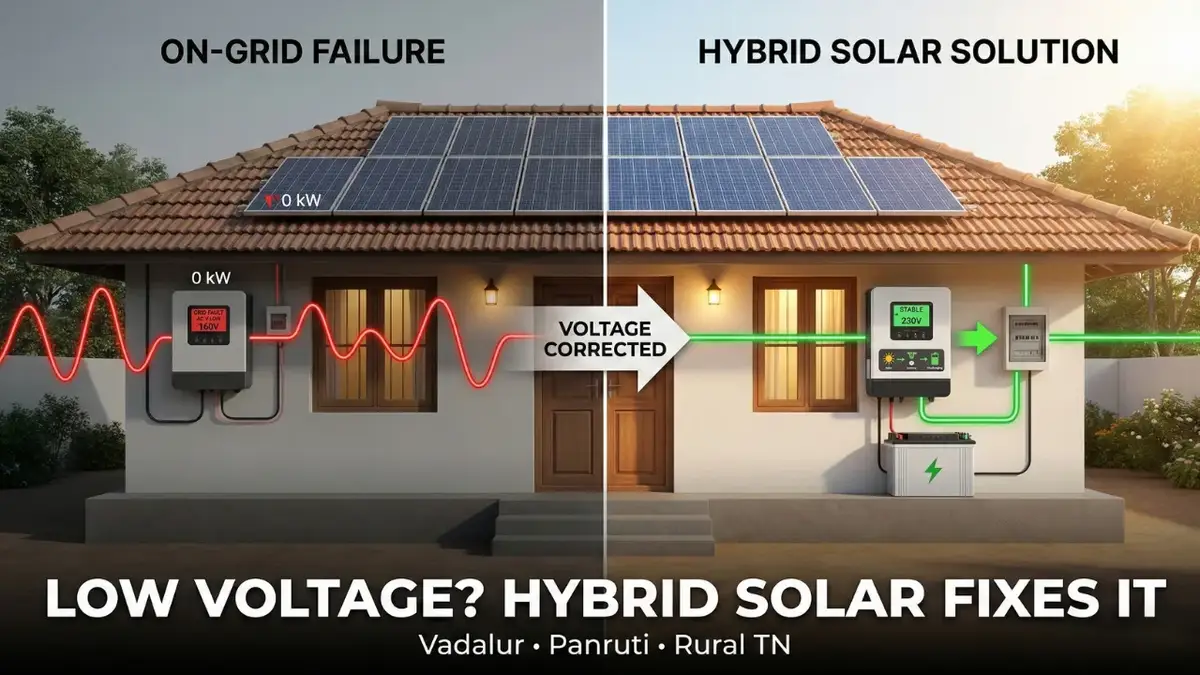
Solar power is great, but it has a specific weakness that few installers talk about: The Grid Reference.
A huge problem plagues homeowners in the rural belts of Cuddalore District—specifically Vadalur, Panruti, Neyveli Outskirts, and Kurinjipadi. The scenario is always the same: "Sir, it is sunny outside, but my Solar Inverter is showing 'Grid Fault' / 'Grid Under Voltage'. I am not generating any power!"
This happens because standard On-Grid inverters are "slaves" to the TNEB grid. If TNEB is weak, Solar is dead.
1. The Physics: Why On-Grid Fails in Villages
Standard On-Grid Inverters (Growatt, Solis, GoodWe, etc.) are programmed to follow precise TNEB safety standards (IEC 61727). They are designed to operate only when the Grid Voltage is "Healthy".
- Healthy Range: 180V to 260V.
- The Rural Reality: In Panruti, electricity is heavily used for Agriculture. Every morning at 9:00 AM, hundreds of farmers switch on their 5HP submersible pumps.
- The Drop: The transformer gets overloaded. The voltage at your home drops to 160V or even 150V.
- The Failure: The Solar Inverter detects 160V. It tries to sync, fails, and displays "AC V Low". It shuts down to protect its internal circuits.
- The Irony: You have blazing sun. You have paid lakhs for panels. But you generate Zero Power from 9 AM to 4 PM (the peak sun hours) because the TNEB voltage is too low.
2. Why a Normal Stabilizer Won't Help
"Can I put a 5kVA Stabilizer before the inverter?" NO.
- Stabilizers are designed for One-Way flow (Grid -> Home).
- Solar is Two-Way flow (Grid <-> Solar).
- If you put a normal stabilizer, the solar inverter will try to push power backwards through it, and the stabilizer coil will burn out in minutes.
3. The Solution: Hybrid Inverters (The "Active Stabilizer")
If you live in a low-voltage zone, do not buy a standard On-Grid inverter. You need a Hybrid Inverter (like Deye, SolaX, or GoodWe GW5048-ES).
Why? What makes it different? Hybrid inverters are "Masters", not slaves.
A. Wide Input Voltage Range
Hybrids are designed for unstable grids (common in South Africa and India). They can usually accept grid voltage as low as 140V or 150V without disconnecting.
B. Island Mode (UPS Mode)
Even if the grid voltage becomes unusable (e.g., drops to 130V), the Hybrid inverter will:
- Disconnect from the dirty TNEB grid (Island itself).
- Keep Running: It creates its own pure 230V reference using the Battery and Panles.
- Result: Your lights, fans, and Fridge keep running on pure solar power, even though the neighbor's tube light is dim and flickering.
Get a Price Estimate for Hybrid Solar
C. Active Voltage Stabilization
When connected to the grid, a Hybrid inverter mixes power sources.
- Input: 160V (Grid) + Solar.
- Output: 230V (Stabilized). It effectively acts like a 5kVA Servo Stabilizer for your entire house.
Experiencing Grid Voltage Issues?
Test your grid voltage and get recommendations for hybrid inverter solutions. Protect your investment from power quality problems.
4. Case Study: Mr. Ramachandran, Panruti
The Situation: Mr. Ramachandran owns a farmhouse near a Jackfruit orchard. The Problem: He installed a 5kW On-Grid system from a Chennai vendor. It never worked between 10 AM and 3 PM. He was frustrated. The Fix: We retrofitted a Deye 5kW Hybrid Inverter and a 5kWh Lithium Battery.
The New Performance:
- Morning (7 AM - 9 AM): Grid is 210V. Solar exports to Grid. battery charges.
- Peak (10 AM - 3 PM): Grid drops to 160V.
- Inverter switches to "Hybrid Mode".
- It stops exporting (because grid is too weak).
- It powers his 1.5 Ton AC and Farm Motor using Solar + Battery.
- Grid consumption is near zero.
- Evening (6 PM): Grid is 180V. Battery powers the lights.
Verdict: He got his ROI back because the system finally runs during the day!
5. The Cost Reality Comparison
Is it expensive? Yes. But you must look at the "Total Cost of Ownership".
Option A: On-Grid (The Failure)
- System Cost: ₹2.5 Lakhs.
- Generation: 0 units (due to voltage trip).
- Value: ₹0.
Option B: Hybrid (The Solution)
- System Cost: ₹4.5 Lakhs.
- Generation: 20 units/day.
- Add-ons: You don't need to buy a separate Home UPS (Save ₹30k) or Mainline Stabilizer (Save ₹20k).
- Value: High ROI + Comfort.
6. How to check YOUR Voltage
Before buying solar, do this test:
- Buy a cheap Digital Voltmeter (₹200) or check your existing stabilizer display.
- Monitor the voltage at 11:00 AM and 2:00 PM on a weekday.
- If it reads below 190V, tell us immediately.
Don't let TNEB voltage dictate your comfort. A Hybrid system is the only engineering solution for Cuddalore's rural power grid.
Frequently Asked Questions
Which inverter is best for Tamil Nadu?
Which inverter is best for Pondicherry?
What inverter do I need for a 3kW system?
Can I add battery later?
Do inverters work during power cuts?
Related Articles
- On-Grid vs Hybrid - Choose the right system
- Enphase Solutions - Premium voltage-independent option
- Zero Export Device - Grid compatibility solutions
Get a Free Rooftop Assessment
Our engineers will visit your site, analyze shadow-free area, and provide a detailed solar report.
Book Free AssessmentTags
Ready to Switch to Solar?
Get a customized solar solution for your home. Save up to 90% on electricity bills!
- Free Site Visit
- Govt. Subsidy Support
- 25 Years Warranty