
Can a 1.5 Ton AC Run on Solar Power in Tamil Nadu? (2026 Ultimate Guide)
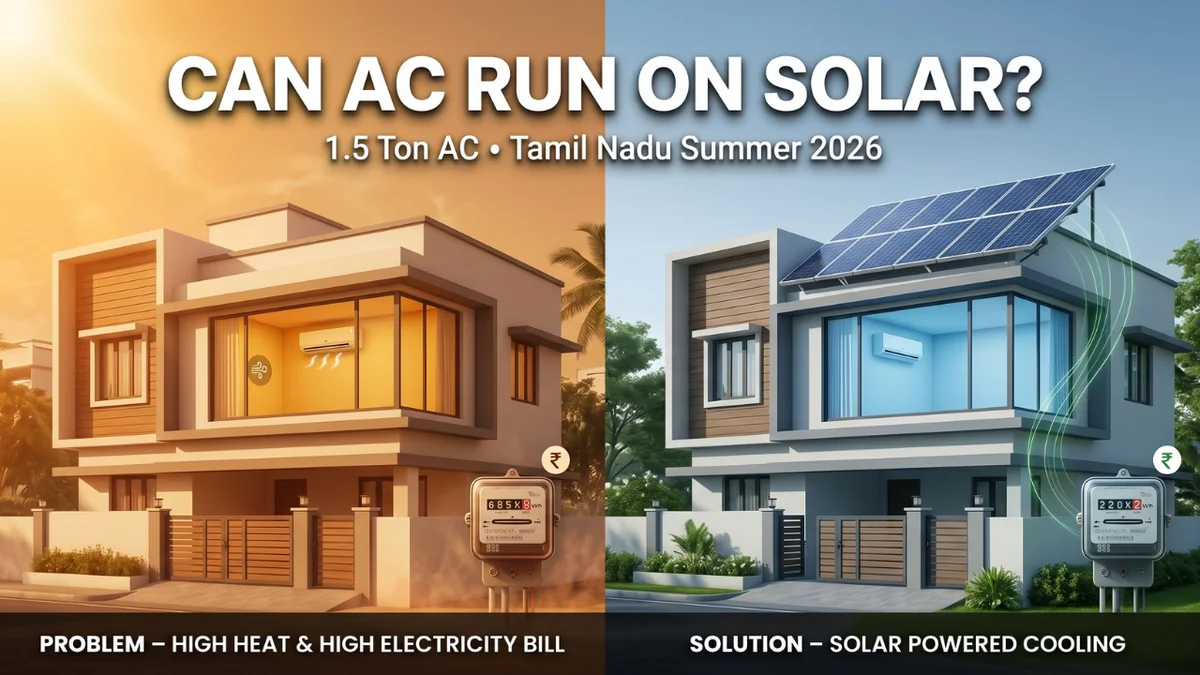
With Tamil Nadu’s sweltering summers pushing temperatures well past 40°C in cities like Cuddalore, Puducherry, Panruti, and Neyveli, running an air conditioner has irrevocably shifted from a luxury to an absolute necessity for health and comfort. However, as the Tamil Nadu Electricity Board (TNEB) tariffs continue to rise—especially if you cross the dreaded 500-unit bimonthly slab—many homeowners are turning to renewable energy to escape crushing utility bills.
At Surya's Solar, the single most common question our engineers receive during site visits is: "Can a 1.5-ton AC run directly on solar power without tripping the system?"
The short answer is an emphatic YES. In fact, running heavy cooling appliances is mathematically the absolute best way to maximize the Return on Investment (ROI) of a residential solar plant. However, the type of solar system you install, your inverter capacity, your AC’s compressor technology, and your daily usage habits will determine exactly how seamlessly you can achieve "free cooling."
In this definitive, 1,500+ word engineering guide, we break down the exact math, common pitfalls to avoid, and the ultimate setup you need to cool your home for free in Tamil Nadu.
1. The Science of AC Power Consumption
Before we can size a solar system to handle an air conditioner, we must intimately understand the electricity consumption of a modern 1.5-ton Air Conditioner. Air conditioners do not draw a constant amount of power; their consumption fluctuates based on the compressor technology, the ambient outside temperature, and the target room temperature.
Inverter vs. Non-Inverter Compressors: The Deep Dive
The technology inside your AC unit plays a massive, often underestimated role in how much solar panel capacity you need to install.
Non-Inverter ACs: These traditional units have a simple ON/OFF compressor. When the room gets warm, the compressor kicks on at 100% capacity. When the target temperature is reached, it shuts off completely.
- The Problem for Solar: When a non-inverter compressor starts, it requires a "surge current" (LRA - Locked Rotor Amps) that is often 3 to 4 times its running current. A standard 1.5-ton non-inverter AC might draw 1,500 Watts while running, but it requires a sudden 4,000+ Watt spike just to start. This massive spike can instantly trip smaller solar inverters.
Inverter ACs: Modern inverter ACs feature a Variable Frequency Drive (VFD) that controls the speed of the compressor motor. Instead of turning on and off, the compressor runs continuously but adjusts its speed based on the cooling demand.
- The Benefit for Solar: Because it ramps up slowly, an inverter AC has almost zero surge current. It starts smoothly at around 200 Watts and gradually climbs. Once the room is cool, the compressor drops to a "maintenance phase," consuming as little as 400 to 500 Watts continuously.
Power Consumption Comparison Table
| AC Technology | Starting Surge (Spike) | Peak Cooling Power | Maintenance Power | Daily Usage (8 Hrs) |
|---|---|---|---|---|
| Old Non-Inverter (3-Star) | 4,000 W | 1,600 W | 1,600 W (On/Off) | 10 to 12 Units (kWh) |
| Modern Inverter (3-Star) | 1,400 W | 1,400 W | 600 W | 6 to 8 Units (kWh) |
| Premium Inverter (5-Star) | 1,100 W | 1,100 W | 400 W | 4 to 5 Units (kWh) |
Golden Engineering Rule: If you are shifting to solar, upgrading old non-inverter ACs to 5-star inverter models is non-negotiable. The money you spend on a new 5-star AC will be instantly recovered by allowing you to buy a smaller, cheaper solar system.
2. Understanding the TNEB "AC Penalty"
To understand why solar is so crucial, you must understand the TNEB billing slabs. In Tamil Nadu, electricity is billed bi-monthly (every two months). The tariff structure is heavily tiered to penalize high consumption.
- 0 - 100 Units: Free
- 101 - 400 Units: ₹4.50 per unit
- 401 - 500 Units: ₹6.00 per unit
- 501 - 600 Units: ₹8.00 per unit
- 601 - 800 Units: ₹9.00 per unit
- 801 - 1000 Units: ₹10.00 per unit
- Above 1000 Units: ₹11.00 per unit
If your house normally consumes 400 units bi-monthly without an AC, your bill is relatively low. However, running a single 1.5-ton non-inverter AC for 8 hours a night adds roughly 600 units to your bi-monthly bill.
This pushes your total consumption to 1,000 units. You are no longer paying ₹4.50 per unit; your new consumption is being penalized at ₹10.00 and ₹11.00 per unit. Your bill doesn't just double—it quadruples. We call this the "AC Penalty."
3. Scenario A: Running an AC on an "On-Grid" Solar System
An On-Grid system is the most popular, cost-effective choice in Tamil Nadu. It is also the system eligible for the highly lucrative PM Surya Ghar Subsidy.
This system does not store electricity in expensive batteries. Instead, it uses the massive TNEB grid as a "virtual battery" via a Net Metering framework.
How the Mechanics Work with Your AC:
- Morning to Afternoon (Daytime Running): If you turn on your AC at 1:00 PM on a hot Saturday, the solar panels on your roof will intercept the sun's energy, convert it to AC power via the grid-tie inverter, and feed it directly into your AC. Your TNEB meter will effectively freeze at "zero."
- Exporting Surplus: Because a 3kW system generates around 3,000 Watts at noon, and your AC only consumes 1,000 Watts, the remaining 2,000 Watts of surplus power is forcefully pushed out of your house and into the TNEB grid. Your net meter records this as "Exported Units."
- Nighttime Running: The sun sets. You go to sleep and turn on your AC. Your house is now completely pulling power from the TNEB grid, just like it did before you had solar.
- The Net Metering Magic: At the end of the two-month billing cycle, the TNEB assessor calculates your bill. They take the hundreds of units you imported at night and subtract the hundreds of units you exported during the day. If you sized your system correctly, the result is zero.
Recommended System Sizing for On-Grid:
To comfortably run one 1.5-ton AC (along with standard household loads like a fridge, 4 fans, TV, washing machine, and LED lights), the absolute minimum requirement is a 3kW On-Grid Solar System.
A highly efficient 3kW plant installed in Cuddalore will generate around 12 to 15 units per day (depending on the season). This perfectly covers the 5 units consumed by the AC at night, plus the 7 units used by the rest of the house.
If you have a larger home with two or three ACs, you must upgrade to a 5kW Solar System, which comfortably generates 20 to 25 units daily.
4. Scenario B: Running an AC on a "Hybrid" System (With Batteries)
If you live in areas with frequent, unpredictable power cuts (such as parts of rural Villupuram, outskirts of Panruti, or deep Neyveli), an On-Grid system won't help you during a blackout. Due to strict "Anti-Islanding" safety regulations, On-Grid inverters must shut down completely when the grid fails.
To run an AC during a power cut, you need a Hybrid Solar System equipped with battery storage.
The Engineering Challenge of Batteries and Air Conditioners
Running heavy heating or cooling loads on batteries is a completely different engineering challenge than running them on the grid.
- Inverter Capacity Constraints: A standard home UPS is usually 1kVA. To run a 1.5-ton AC, you need an inverter capable of handling at least 3,000 Watts continuously. If you run an AC, a fridge, and a water pump simultaneously during a power cut, a 3kW hybrid inverter will trip due to overload. You need a 5kW Hybrid Inverter (like Deye or Growatt) to ensure system stability.
- Battery Discharge Rates (C-Rating): Batteries do not like to be drained rapidly. If you pull 1,500 Watts from a standard Lead-Acid battery bank, the voltage sags, the batteries overheat, and their lifespan degrades quickly.
- Battery Sizing for Night Use: To run a 1.5-ton AC for just 4 hours during a night-time power cut, you need roughly 5kWh of stored battery energy. Because Lead-Acid batteries should only be discharged to 50% (Depth of Discharge) to prevent damage, you actually need a 10kWh battery bank. This translates to four massive 150Ah tall tubular batteries, or ideally, a modern 48V 100Ah Lithium-ion (LiFePO4) battery pack.
Verdict for Hybrid: Yes, you can absolutely run an AC during a power cut, but you must be prepared to invest in a robust, heavy-duty 5kW Hybrid System with Lithium-ion batteries. Trying to run an AC on a cheap, undersized off-grid setup is a guaranteed recipe for fried inverters and dead batteries.
5. Top 5 Tips for Maximizing AC Efficiency on Solar
To extract the absolute maximum value out of your solar investment while keeping your home freezing cold during the Tamil Nadu summer, follow these engineering best practices:
- Thermal Pre-Cooling During Peak Sun: If you have an On-Grid system, do not wait until 6 PM to turn on your AC. Turn your AC on and set it to 22°C between 1 PM and 4 PM while your solar panels are generating maximum peak power. Your house's walls, furniture, and air will act like a "thermal battery," storing the cold. In the evening, you can raise the AC to 26°C or rely entirely on ceiling fans, drastically minimizing your nighttime grid import.
- Maintain Your Panels Relentlessly: During the dry, dusty months of April and May—right when you need your AC the most—dust accumulation on solar panels can drop power generation by a staggering 15% to 20%. Wash your panels with plain water (no harsh chemicals) at least twice a month early in the morning.
- Stagger Your Heavy Loads: If you have two ACs, do not turn them on at the exact same second. Turn the first one on, wait 10 minutes for its compressor to settle into its low-power maintenance phase, and then turn on the second one. This prevents extreme voltage drops that can stress the inverter components.
- Set the Right Temperature: Every degree below 24°C increases your AC's power consumption by roughly 6%. Setting your AC to 18°C does not cool the room any faster; it simply forces the compressor to run at 100% capacity continuously without ever ramping down. Keep it at 24°C for maximum solar efficiency.
- Seal Your Room: Solar energy is essentially "free," but that doesn't mean you should waste it. Ensure your windows have thick blackout curtains to block radiant heat from the sun, and seal gaps under doors to prevent your hard-earned cold air from escaping into hallways.
6. Financial Breakdown: The ROI of Solar Air Conditioning
Let's look at a real-world case study of a 3 BHK home in Cuddalore that installed a 5kW On-Grid system to support two 1.5-ton ACs.
- Average Bi-monthly TNEB Bill Before Solar: ₹8,500 (Heavily penalized in the high slabs).
- Annual Electricity Cost: ₹51,000.
- Cost of a Premium 5kW On-Grid System: Approximately ₹2,80,000.
- PM Surya Ghar Subsidy Received: ₹78,000.
- Net Cost to Customer: ₹2,02,000.
- New Bi-monthly TNEB Bill After Solar: ₹0 to ₹150 (Fixed charges only).
- Payback Period: ₹2,02,000 / ₹51,000 = 3.9 Years.
After roughly 4 years, the system has completely paid for itself. Because Tier-1 solar panels have a 25-year performance warranty, the homeowner will enjoy 21 years of completely free air conditioning. This represents a guaranteed, tax-free return on investment that outperforms almost any mutual fund or fixed deposit available in India.
7. Frequently Asked Questions (FAQs)
Q: Can I run my AC directly from the solar panels without an inverter, just connecting the wires? A: Absolutely not. Standard home Air Conditioners require 230V Alternating Current (AC) to operate their motors. Solar panels produce raw Direct Current (DC). You absolutely need a high-quality solar inverter to convert the DC power to AC power, and you need either the TNEB grid or a battery bank to stabilize the constantly fluctuating voltage of the sun.
Q: Will the government subsidy cover a system large enough to run my AC? A: Yes! Under the PM Surya Ghar Muft Bijli Yojana, you can get a massive ₹78,000 subsidy for a 3kW system. As we established, a 3kW system generates enough units to completely offset the usage of one 1.5-ton AC. The subsidy scales down after 3kW, making a 3kW plant the absolute "sweet spot" for maximizing government assistance.
Q: Does bad weather or monsoon season affect my ability to run the AC? A: On cloudy days or during the heavy Tamil Nadu monsoons, your solar panels will naturally produce less power. However, with an On-Grid system, the TNEB grid seamlessly provides whatever extra power your AC needs in real-time. You won't notice a single difference in cooling performance. Your net-metering credits will be slightly lower for that specific day, but the massive surplus generated during the summer months will easily balance out the deficit during the monsoon.
Q: If the power goes out during the day, will my On-Grid solar panels still run my AC? A: No. By strict government law (Anti-Islanding protection), an On-Grid inverter must shut down within milliseconds of a grid failure. This protects TNEB linemen working on the street poles from being electrocuted by power exported from your roof. To run appliances during a daytime power cut, you must have a Hybrid system with batteries.
Conclusion: Stop Paying the "AC Penalty"
Running your air conditioning on solar power is no longer a futuristic dream; it is the smartest, most mathematically sound financial decision you can make as a homeowner in Tamil Nadu today.
By understanding your compressor technology and properly sizing your plant, a 3kW or 5kW solar system will completely wipe out the massive tariff spikes on your bi-monthly TNEB bill, paying for itself in under 4 years.
Are you ready to cool your home for free without worrying about the next electricity bill?
Book a free, zero-obligation site visit and engineering feasibility check with Surya's Solar today! Our team of experts will analyze your roof space, calculate your exact AC usage, and design a custom solar plant that guarantees maximum ROI.
Tags
Ready to Switch to Solar?
Get a customized solar solution for your home. Save up to 90% on electricity bills!
- Free Site Visit
- Govt. Subsidy Support
- 25 Years Warranty