
Do You Need a Stabilizer for an Inverter AC on Solar Power? (2026 Ultimate Guide)
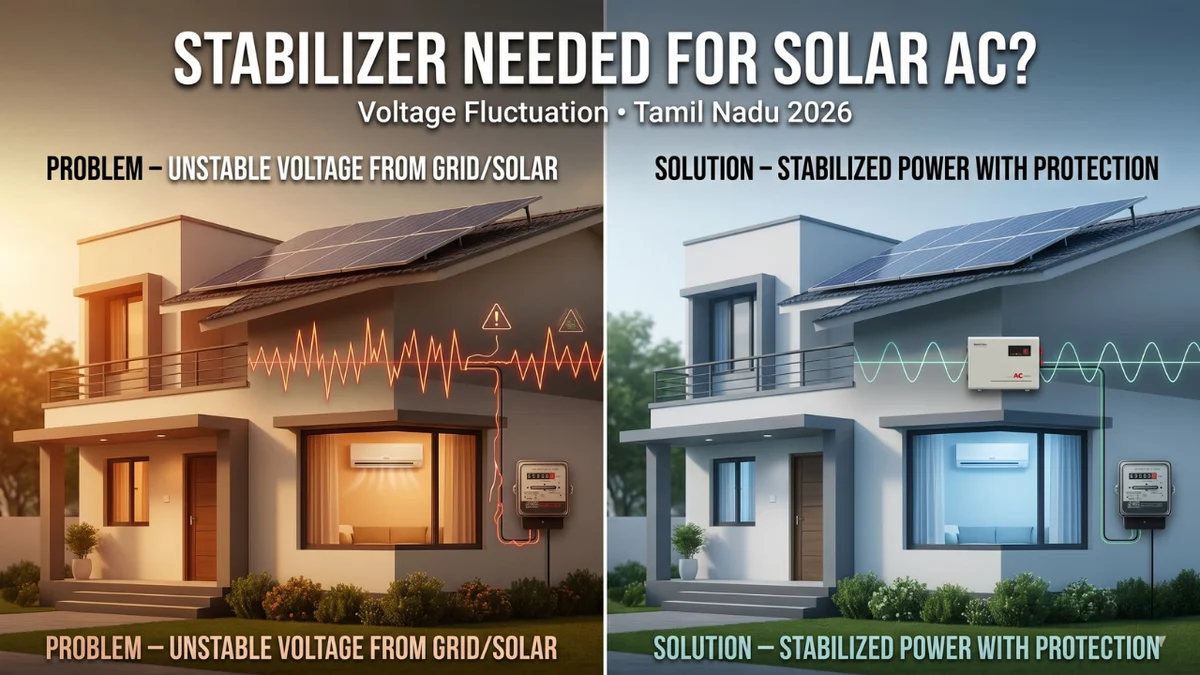
When buying a brand new, premium Inverter Air Conditioner, the appliance showroom salesman will almost certainly point to a brightly colored sticker on the box and proudly announce: "Sir, this model features 100% stabilizer-free operation! You do not need to buy anything else!"
This marketing claim is highly appealing. Nobody wants to spend an extra ₹2,500 and drill more holes in their pristine living room walls for a bulky metal box.
But when you connect that same state-of-the-art Air Conditioner to a rooftop solar system in Tamil Nadu—especially in areas notorious for severe grid fluctuations like Panruti, Neyveli, rural Cuddalore, or the industrial outskirts of Puducherry—the engineering rules of the game change completely.
Do you actually need an external voltage stabilizer for your highly advanced Inverter AC when running on a solar power plant? Does connecting a stabilizer to a solar inverter cause "double regulation" conflicts?
Let’s look past the glossy appliance marketing jargon and dive deep into the technical reality of Printed Circuit Boards (PCBs), solar inverter synchronization, and TNEB voltage sags in this definitive 1,500+ word engineering guide.
1. The Anatomy of an Inverter AC: What Does "Stabilizer-Free" Actually Mean?
To answer the core question, we first need to understand what an Inverter AC is doing internally that makes it so different from old-school, non-inverter air conditioners.
The Magic of the PCB
Traditional ACs have a simple, brute-force compressor. It turns on at 100% speed, blasts cold air until the room is freezing, and then completely shuts off. Modern Inverter ACs, however, feature a highly sophisticated internal microcomputer known as a PCB (Printed Circuit Board). This PCB controls a Variable Frequency Drive (VFD), which allows the compressor motor to smoothly ramp up and modulate its speed based on the exact temperature of the room.
Because of this advanced internal power circuitry, the PCB is designed to handle a specific range of voltage fluctuations without instantly breaking. Typically, major AC brands (like Daikin, LG, Voltas, and Blue Star) advertise a "safe working voltage range" of 145V to 290V.
If the incoming AC voltage from the TNEB grid (or your synchronized solar inverter) stays perfectly within this wide 145V–290V window, the AC’s internal circuitry regulates the power itself, and the compressor continues to run smoothly.
However, there are three massive engineering problems with relying solely on this internal protection:
- Hard Tripping Limits: If a severe grid fault causes the voltage to suddenly drop to 130V (a "brownout") or spike to 310V (a "surge"), the AC's internal protection mechanism will simply trip and shut the entire unit down to protect the compressor. You lose cooling immediately, often in the middle of a sweltering summer night.
- Thermal PCB Fatigue: This is the silent killer. Constant, rapid voltage fluctuations within that "safe" range force the delicate components on the internal PCB to work in overdrive to stabilize the current before it reaches the compressor motor. Over months and years of operating in a fluctuating grid, this constant electrical stress generates extreme excess heat on the board.
- The Cost of Failure: Thermal fatigue eventually causes microscopic capacitors or resistors on the PCB to pop or burn out. When this happens, the entire AC stops working. Because the PCB is a proprietary, highly complex microcomputer, mechanics cannot simply solder a new wire. You must replace the entire board. Replacing a burnt Inverter AC PCB costs between ₹10,000 to ₹18,000. It is the most expensive component in the entire machine next to the compressor itself.
2. The Solar Factor: Scenario A - On-Grid Solar Systems (No Battery)
Now, let's introduce solar power into the equation. If you have an On-Grid Solar System, your solar inverter is directly synchronized with the TNEB utility grid. This is the most common, cost-effective setup in India and the one eligible for the massive PM Surya Ghar subsidy scheme.
- The Harsh Reality of On-Grid: An On-Grid solar inverter is highly advanced, but it does not actively regulate or fix the voltage of the utility grid for your house. Its job is to detect the exact voltage and frequency of the TNEB grid, precisely match it, and inject solar current alongside it.
- What This Means for Your AC: If a local transformer fault causes the TNEB supply to drop to 180V, your On-Grid solar inverter will obediently synchronize to 180V. Your house, and therefore your expensive Inverter AC, receives 180V. If an industrial load shuts off down the street and the grid suddenly surges to 260V, your house receives 260V.
- The Final Engineering Verdict: If you live in an area with a highly stable, underground-cabled TNEB voltage (like the core commercial centers of Puducherry or specific zones in Chennai), you might be perfectly safe operating without a stabilizer. However, if you live in standard residential or semi-rural areas in Tamil Nadu that experience sudden voltage spikes, frequent power cuts, or severe low-voltage phases during peak summer load shedding, YES, you absolutely must install a dedicated AC stabilizer.
The Economic Reality Check: Why take an unnecessary risk? Do not risk a ₹15,000 PCB replacement on a ₹45,000 Air Conditioner for the sake of saving ₹2,000 on a stabilizer. Treat the external stabilizer as an extremely cheap, sacrificial insurance policy. If lightning strikes or a massive grid surge occurs, the ₹2,000 stabilizer will blow its fuse and die, completely protecting your ₹45,000 AC behind it.
3. The Solar Factor: Scenario B - Hybrid or Off-Grid Solar Systems (With Battery)
If you have a Hybrid Solar System equipped with a large battery bank (Lithium-ion or Lead-Acid), the electrical dynamics of your home change entirely.
- The Reality of Hybrid Technology: High-quality Hybrid Inverters (manufactured by tier-1 brands like Deye, Growatt, or Luminous) are not just synchronizing devices; they are complete power management hubs. Premium hybrid inverters feature a built-in Automatic Voltage Regulator (AVR). Furthermore, when the TNEB grid fails completely, they isolate your house from the street and output a mathematically perfect, pure sine wave 230V AC current directly from the solar panels and batteries.
- The Final Engineering Verdict: When your home is running strictly on battery or direct solar backup during a power cut, the Hybrid Inverter provides a perfectly stable, unfluctuating 230V output. In this specific, isolated scenario, NO, you do not technically need an external stabilizer for the AC, because the Hybrid Inverter itself is acting as a massive, whole-house servo stabilizer.
The Crucial Bypass Caveat: Even with a highly expensive Hybrid system, when grid power is present and deemed "normal," many hybrid inverters automatically switch into "Bypass Mode." To maximize efficiency and prevent unnecessary wear on the inverter circuitry, it passes the raw TNEB grid voltage directly straight through to your home's distribution panel. In Bypass Mode, your AC is once again exposed to the raw grid. Therefore, even with a Hybrid system, a dedicated AC stabilizer remains highly recommended by engineers.
4. Understanding Stabilizer Types: Relay vs. Servo Technology
If you make the wise decision to protect your investment and buy a stabilizer, you must ensure you purchase the correct technology. Not all stabilizers are created equal.
| Stabilizer Technology | How it Operates Internally | Best Use Case | Price Range |
|---|---|---|---|
| Relay Stabilizer | Uses mechanical electromagnetic relays to switch transformer voltage taps up or down in discrete steps (e.g., jumping from 190V to 210V). | Standard home use, protecting against moderate fluctuations and surges. (e.g., V-Guard, Microtek) | ₹1,500 - ₹3,500 |
| Servo Stabilizer | Uses a motorized servo mechanism sliding across a toroidal transformer for continuous, step-less, 1% accuracy voltage correction. | Heavy industrial machinery, medical equipment, or rural areas with extreme, violent voltage swings. | ₹6,000 - ₹15,000+ |
| Static Stabilizer | Uses pure solid-state electronics (IGBTs) with zero moving parts for instantaneous correction. | Highly sensitive IT servers and data centers. Overkill for home ACs. | ₹20,000+ |
For a standard 1.5-ton residential Inverter AC operating on a residential solar setup, a high-quality Relay Stabilizer (rated for 4kVA or 4000W) with a wide operating window (e.g., 130V to 300V) is more than sufficient to provide a bulletproof shield for your PCB.
5. Busting the "Double Regulation" Myth
One of the most persistent myths we hear from customers—and even some uneducated electricians—is the fear of "Double Regulation."
The concern usually goes like this: "Won't connecting an external stabilizer to my AC, while I already have a smart solar inverter, cause the two devices to fight each other? Won't double regulation confuse the AC's internal PCB?"
This is a fundamental misunderstanding of how relay stabilizers work.
A high-quality relay-based stabilizer is an essentially passive device under normal conditions. If the incoming voltage from your solar inverter / TNEB grid is a healthy, normal 230V, the stabilizer does absolutely nothing. It simply acts as a wire, passing the current straight through to the AC.
It only kicks into action (you will hear an audible, physical 'click' as the relay fires) when it detects a dangerous anomaly—like the voltage sagging to 170V. When it clicks, it boosts the voltage back to a safe 220V before handing it to the AC.
It will never interfere with your solar inverter's operation. It will never confuse your AC's internal inverter. It simply acts as an unyielding bouncer at the door, guaranteeing that the AC's delicate internal microcomputer never has to sweat or overheat trying to regulate bad, dirty voltage.
6. Frequently Asked Questions (FAQs)
Q: My Air Conditioner brand states they will void the warranty if I don't use a stabilizer. Is this legal and true? A: Yes, it is often true. Many major AC brands maintain clauses in their fine print stating that in areas known for poor power quality (which covers much of rural India), the warranty covering the PCB is void if a dedicated stabilizer is not installed. Always read the specific warranty card of your Daikin, LG, or Voltas unit, as replacing a PCB out-of-pocket is disastrously expensive.
Q: What exact capacity stabilizer do I need to buy for a 1.5-ton Inverter AC? A: You must purchase a stabilizer rated for at least 4kVA (or 4000 Watts). Even though a 1.5-ton inverter AC only uses 1,500 Watts while running, you need the extra headroom in the stabilizer's transformer to handle surge currents and ensure the stabilizer itself doesn't overheat during long, continuous 12-hour nighttime operations.
Q: Can I use one giant, whole-house stabilizer for the entire property instead of buying individual ones for each AC? A: Yes, a mainline whole-house servo stabilizer installed directly after your TNEB meter can protect every single appliance in your home simultaneously. However, it must be sized perfectly by a qualified engineer (typically requiring a 5kVA to 10kVA unit for a standard home). These mainline stabilizers are significantly more expensive and bulky. Buying individual ₹2,000 AC stabilizers is usually a much more cost-effective, targeted approach for most homeowners.
Q: Do stabilizers consume their own electricity? Will it ruin my solar savings? A: Stabilizers do consume a tiny amount of power to run their internal circuitry and LED displays, but it is entirely negligible. A modern relay stabilizer consumes roughly 10 to 15 Watts per hour. Over an entire month, it might consume 2 or 3 units of electricity. The massive savings generated by your 3kW or 5kW solar plant will completely dwarf this tiny consumption.
Financial Breakdown: The ROI of Protected Air Conditioning
Let's examine the financial and technical realities of protecting your Inverter AC when running on solar power in Tamil Nadu.
The Cost-Benefit Analysis
- Cost of a Quality Stabilizer: ₹2,000 - ₹3,000 (One-time investment)
- Cost of PCB Replacement (Without Stabilizer): ₹10,000 - ₹18,000 (Plus ₹5,000 service charges)
- Probability of PCB Failure in Fluctuating Grid Areas: 15-25% within 3 years
- Expected Lifespan of Protected AC: 10+ years
- Payback Period for Stabilizer: Less than 1 year (If it prevents even one PCB failure)
Technical Integration with Solar Systems
When integrating stabilizers with solar inverters:
- On-Grid Systems: Stabilizer should be placed after the solar inverter's output, before the AC.
- Hybrid Systems: Stabilizer provides backup protection during bypass mode.
- Sizing Rule: Stabilizer capacity should be 2.5x the AC's running watts (e.g., 4kVA for 1.5-ton AC).
The Complete Solar AC Setup Cost Breakdown (2026)
- 3kW On-Grid Solar System: ₹1,80,000 (After ₹78,000 subsidy)
- Premium 1.5-Ton Inverter AC: ₹45,000
- Dedicated AC Stabilizer: ₹2,500
- Total Investment: ₹2,27,500
- Annual Electricity Savings: ₹25,000+ (From free AC usage)
- Payback Period: 9 years (But AC lasts 10+ years, solar 25+ years)
Engineering Verdict: The stabilizer is not an optional accessory; it is a mandatory component for long-term reliability. The ₹2,500 investment protects a ₹45,000 AC and ensures your solar investment delivers maximum ROI without unexpected breakdowns.
Conclusion: Engineering Peace of Mind
At Surya's Solar, we design, engineer, and install hundreds of residential and commercial solar power plants across Tamil Nadu every single year. We have seen firsthand the devastating effects of grid fluctuations on expensive modern appliances. Our engineering advice to every single customer remains universal and unyielding:
If you are installing a 3kW or 5kW On-Grid Solar System and you intend to run expensive, modern Inverter ACs, spend the extra ₹2,000 to ₹3,000 and install a high-quality stabilizer (from reputable brands like V-Guard, Microtek, or Everest) for each individual AC unit.
The internal PCB of your new Inverter AC is a highly fragile microcomputer, not a heavy-duty industrial transformer. A dedicated external stabilizer acts as a cheap, rugged, sacrificial shield standing between the erratic TNEB utility grid, your solar inverter, and your precious air conditioning unit.
Invest in protection today, and enjoy decades of free, icy-cold, stress-free solar cooling.
Do you have more technical questions about integrating heavy household appliances, electric vehicle chargers, or water pumps with your new solar plant? Contact the engineering team at Surya's Solar today for a free, comprehensive technical consultation!
Tags
Ready to Switch to Solar?
Get a customized solar solution for your home. Save up to 90% on electricity bills!
- Free Site Visit
- Govt. Subsidy Support
- 25 Years Warranty