
Why Is My Electricity Bill So High in Summer? (Tamil Nadu 2026 Guide)
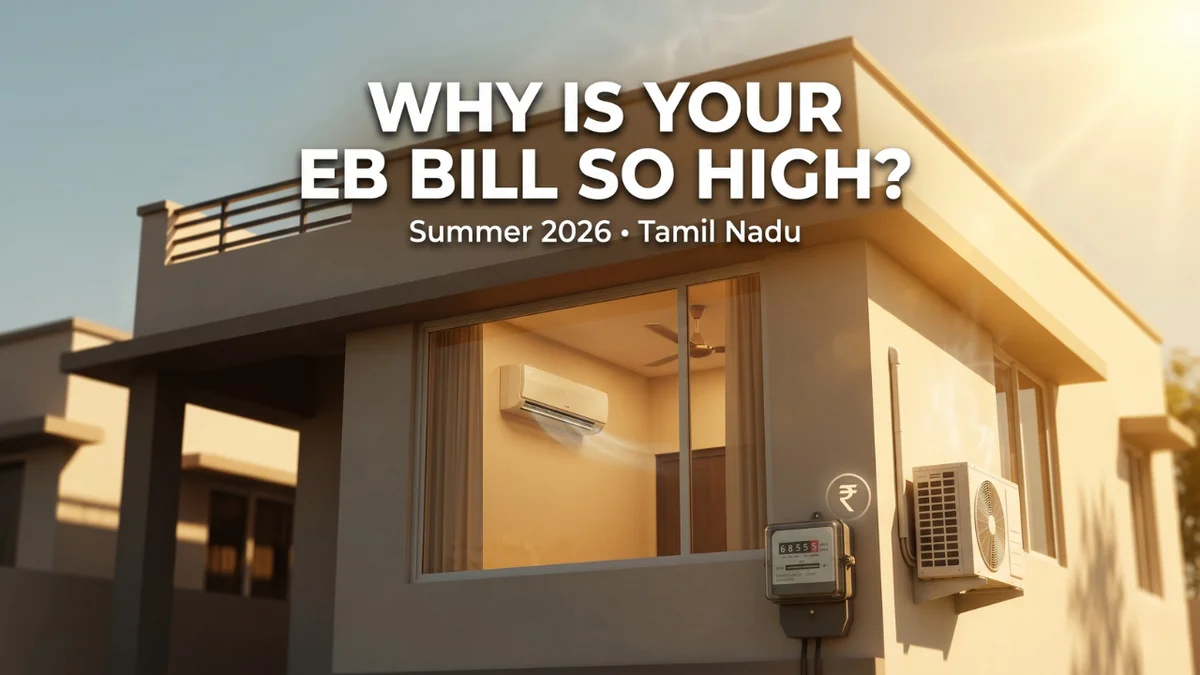
Every year between April and July, millions of residents across Tamil Nadu—from Cuddalore and Puducherry to Chennai and Coimbatore—open their bi-monthly TNEB (Tamil Nadu Generation and Distribution Corporation) SMS or app notification and experience severe sticker shock.
"Current bill high why?" is one of the most frequently asked questions in local community groups during peak summer. It is not uncommon for a household that pays ₹1,500 in December to suddenly receive a ₹6,000 to ₹8,000 electricity bill in May.
Many homeowners immediately suspect a faulty meter or an error by the EB assessor. However, in 99% of cases, the meter is perfectly fine. The massive spike in your electricity bill is a combination of harsh environmental physics and the rigid mathematics of TNEB's telescopic tariff structure.
In this comprehensive engineering guide, we break down exactly why your EB bill is so high in the summer and what you can authentically do to fix it without sacrificing your family's comfort.
1. The Telescopic Tariff: The "500-Unit Cliff"
To understand your high bill, you must first understand how TNEB charges you for electricity. Tamil Nadu uses a "telescopic tariff" system. This means that the more electricity you use, the higher the price per unit becomes. You are not charged a flat rate.
Electricity is billed bi-monthly (once every two months). Let's look at the standard domestic tariff slabs (as of recent revisions):
- 0 to 100 Units: Free (₹0)
- 101 to 400 Units: ₹4.50 per unit
- 401 to 500 Units: ₹6.00 per unit
If your bi-monthly consumption stays strictly under 500 units, your bill remains highly subsidized. However, the moment your household consumes 501 units, you fall off a financial cliff.
Once you cross 500 units, the subsidy heavily drops, and the pricing structure completely shifts:
- 101 to 400 Units (revised rate): ₹4.50 per unit
- 401 to 500 Units: ₹6.00 per unit
- 501 to 600 Units: ₹8.00 per unit
- 601 to 800 Units: ₹9.00 per unit
- 801 to 1000 Units: ₹10.00 per unit
- 1001+ Units: ₹11.00 per unit
The Summer Trap
During the winter months (November to February), a standard 2-BHK home might consume around 350 to 450 units bi-monthly. The bill remains firmly in the safe, subsidized zone.
But when summer hits, the usage of Air Conditioners and fans increases. If your usage jumps from 450 units to 850 units, your consumption has not even doubled. However, because you crossed into the ₹9.00 and ₹10.00 slabs, your final bill will more than triple.
This is the primary reason why your bill feels disproportionately high in the summer. It is not a linear increase; it is an exponential penalty.
2. The Physics of Ambient Temperature on Air Conditioners
The most obvious culprit for high summer bills is the Air Conditioner. But many homeowners ask: "I run my AC for 8 hours in December and 8 hours in May. Why does it use so much more power in May?"
The answer lies in thermodynamics. An air conditioner does not create cold air; it extracts heat from inside your room and pumps it outside.
- The Temperature Delta: In December, the outside temperature in Cuddalore might be 28°C at night. If you set your AC to 24°C, the compressor only has to overcome a "delta" (difference) of 4 degrees. It achieves this quickly and then shuts off or ramps down.
- The Summer Strain: In May, the outside temperature can be 38°C even late into the evening. To reach that same 24°C, the compressor now has to overcome a massive 14-degree delta. Furthermore, the outside condenser unit is trying to reject heat into outside air that is already scorching hot, heavily reducing its thermodynamic efficiency.
- The Result: Your AC compressor, which might have run for 3 hours total in December, is now running at 100% capacity for 7 hours straight in May to achieve the exact same room temperature. Even if your usage hours haven't changed, the actual power drawn from the grid has easily doubled.
3. The Refrigerator Overdrive
Your AC isn't the only appliance fighting the heat. Your refrigerator is essentially an insulated box with a small AC attached to the back.
During the summer:
- The ambient temperature in your kitchen rises significantly.
- You open the fridge door more frequently for cold water or ice.
- Every time you open the door, 35°C air rushes in, completely replacing the 4°C air inside.
To compensate for the hot kitchen and frequent door openings, the refrigerator's compressor runs almost constantly. A standard double-door fridge that consumes 1.5 units a day in winter can easily consume 3 units a day in summer. Over a 60-day billing cycle, that single appliance just added 90 units to your bill—pushing you dangerously close to the higher TNEB tariff slabs.
4. Ceiling Fans and Water Pumps
While an individual ceiling fan only consumes about 70 Watts, summer changes how we use them.
- Constant Operation: In summer, fans are often left running 24/7 in every occupied room. Four ceiling fans running 20 hours a day will consume roughly 5.6 units per day. Over 60 days, that is nearly 340 units purely from ceiling fans.
- Water Scarcity: Tamil Nadu summers often bring municipal water scarcity. Households relying on borewells or sumps must run their 1 HP or 1.5 HP water pumps much more frequently to draw water from depleted water tables. A 1 HP pump consumes about 750 Watts. Running it an extra hour a day adds another 45 units to your bi-monthly bill.
5. Inefficient Appliances and Poor Maintenance
If your bill is consistently higher than your neighbors despite having the same appliances, inefficiency is the likely culprit.
Dirty Filters
An Air Conditioner with a clogged dust filter cannot push air effectively. Because the room isn't cooling down, the thermostat never signals the compressor to turn off. The compressor runs endlessly. Simply washing your AC filters every two weeks during the summer can reduce its power consumption by 10% to 15%.
Non-Inverter vs. Inverter Technology
Old, 3-star non-inverter ACs use a brute-force on/off mechanism that draws a massive surge of current every time the compressor starts. If you are using a 5-year-old non-inverter AC, it is easily consuming 40% more electricity than a modern 5-star Inverter AC. Replacing old, heavily used ACs is often the fastest way to drop back down into a lower TNEB tariff slab.
6. How to Authentically Reduce Your Summer Bill
There are no "magic devices" that plug into the wall and magically slash your EB bill. (Beware of cheap "power saver" boxes sold online—they are mostly scams utilizing simple capacitors that do nothing to reduce residential meter readings). Real savings require behavioral changes and engineering solutions.
Behavioral Changes:
- Set ACs to 24°C or 26°C: Every single degree you lower your thermostat below 24°C increases the AC's power consumption by 6%. Setting your AC to 18°C does not cool the room faster; it simply forces the compressor to run nonstop.
- Use Fans with AC: Set your AC to 26°C and run the ceiling fan at a medium speed. The wind chill effect makes 26°C feel like 23°C to the human body, but consumes drastically less power.
- Shade Your Outdoor AC Unit: If your AC's outdoor condenser unit is baking in direct afternoon sunlight, it loses efficiency. Providing a simple sunshade (while ensuring excellent airflow) can improve its efficiency by up to 5%.
The Ultimate Engineering Solution: Rooftop Solar
If your bi-monthly summer bill consistently crosses ₹3,000, behavioral changes will only yield marginal relief. You are trapped in the high TNEB tariff slabs.
The only mathematically proven, permanent way to eliminate high summer electricity bills in Tamil Nadu is to install a Grid-Tied Rooftop Solar System.
Why Solar is the Perfect Match for Summer: The very same scorching sun that causes your AC to work overtime is exactly what makes your solar panels produce peak power.
- A 3kW On-Grid Solar System installed on a shadow-free roof in Cuddalore or Puducherry will generate around 12 to 15 units of electricity every single day during the summer.
- Over a 60-day TNEB billing cycle, the system injects roughly 720 to 900 units into the grid.
- Through the Net Metering system, these generated units are directly subtracted from your total consumption.
If your total summer consumption was 1,000 units, the solar system subtracts 900 units. TNEB will only bill you for the remaining 100 units—which fall into the "Free" slab! Your massive ₹10,000 summer bill instantly becomes zero.
Furthermore, with the introduction of the PM Surya Ghar Subsidy, homeowners can receive a massive ₹78,000 direct subsidy to install a 3kW system, making the Return on Investment (ROI) incredibly fast (usually under 4 years).
Financial Breakdown: Beating the Summer Bill Spike
Technical Sizing for Summer Load
To offset high summer consumption:
- Calculate Peak Load: AC usage + fans + lights during 6 PM-11 PM peak hours
- Solar Generation Factor: 4-5 hours of peak sun in summer = 3kW system generates 12-15 units/day
- Battery Backup Option: For power cuts, add 3kW battery for uninterrupted AC operation
Financial Breakdown: The Summer Solar ROI
- Average Summer Bill (Without Solar): ₹6,000 - ₹8,000 bi-monthly
- Annual Summer Cost: ₹36,000 - ₹48,000
- 3kW Solar System Cost: ₹1,80,000 (After ₹78,000 subsidy = ₹1,02,000 net)
- Monthly Savings: ₹3,000 - ₹4,000 (From free AC and appliances)
- Payback Period: 2.5 - 3.5 years
- 25-Year Lifespan Savings: ₹4,50,000+ (Tax-free)
Subsidy and Loan Options (2026)
- PM Surya Ghar: ₹78,000 direct subsidy for 3kW systems
- Bank Loans: 8-9% interest, EMI as low as ₹2,200/month
- Green Finance: Additional tax benefits and faster approvals
Engineering Insight: Solar doesn't just reduce your bill; it eliminates the tariff penalty entirely. Your summer consumption stays in subsidized slabs while solar credits keep you in the free zone.
Conclusion
Your high summer electricity bill is not a mistake; it is a mathematical certainty caused by the physics of heat extraction and the punishing TNEB telescopic tariff slabs. While regular maintenance and disciplined AC temperature settings can shave a few hundred rupees off your bill, the only true escape from the "AC Penalty" is generating your own power.
Are you tired of fearing your summer EB bill? Contact the engineering experts at Surya's Solar today for a free roof assessment and find out exactly how much a subsidized solar plant can save your family this year.
Tags
Ready to Switch to Solar?
Get a customized solar solution for your home. Save up to 90% on electricity bills!
- Free Site Visit
- Govt. Subsidy Support
- 25 Years Warranty