
How Many Units Does an AC Consume Per Day in India? (2026 Engineering Guide)
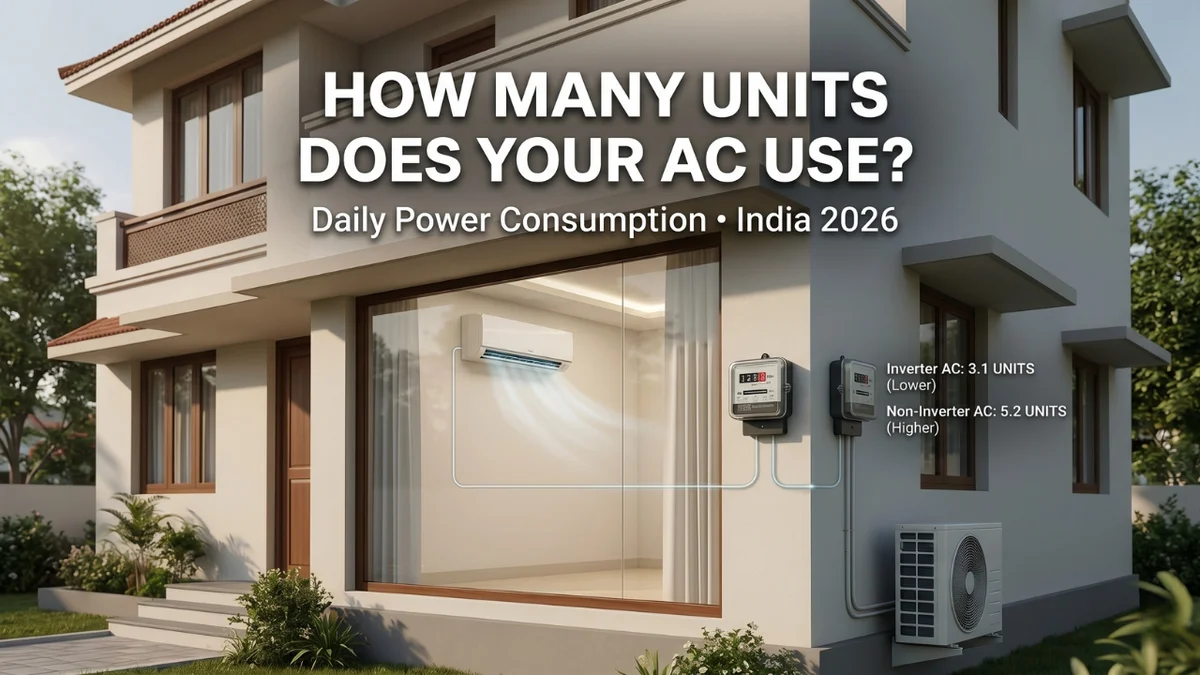
Whether you live in the humid coastal belts of Tamil Nadu or the dry heat of northern India, surviving the summer without an Air Conditioner is nearly impossible. However, the relief of cold air is almost immediately followed by a wave of anxiety regarding the impending electricity bill.
The most common question we receive from homeowners trying to budget their utility costs—or size a new rooftop solar plant—is: "Exactly how many units does an AC consume per day in India?"
Unfortunately, you cannot simply look at the sticker on the side of your AC to find the answer. Air conditioners do not consume power at a flat, constant rate like a lightbulb. Their power consumption fluctuates violently based on compressor technology, ambient outside temperature, room insulation, and thermostat settings.
In this comprehensive, 1,500+ word engineering guide, we abandon generic estimates and provide the exact mathematical formulas, comparison tables, and real-world variables you need to calculate your precise AC power consumption.
1. The Core Variable: Inverter vs. Non-Inverter Technology
The single largest factor in determining how many units your AC will consume is the type of compressor technology it uses. If you do not know whether you own an "Inverter" or "Non-Inverter" AC, you cannot calculate your bill accurately.
Non-Inverter ACs (The Old Standard)
A traditional non-inverter AC uses a simple, brute-force ON/OFF compressor mechanism.
- When you turn it on, the compressor kicks in at 100% capacity, drawing maximum wattage.
- When the room reaches the target temperature (e.g., 24°C), the compressor violently shuts off completely.
- When the room warms up slightly, it violently kicks back on at 100% capacity, pulling a massive "surge current" every single time it starts.
- The Result: High power consumption, noisy operation, and massive strain on your electrical grid.
Inverter ACs (The Modern Standard)
An Inverter AC features a sophisticated Variable Frequency Drive (VFD) attached to the compressor motor.
- When you turn it on, the compressor starts smoothly and ramps up to full power.
- When the room reaches the target temperature, the compressor does not shut off. Instead, it intelligently slows down its speed to a gentle "maintenance phase."
- It continuously modulates its speed to keep the room perfectly at 24°C.
- The Result: No surge currents, near-silent operation, and massive power savings (up to 40% more efficient than non-inverters).
2. Understanding "Tonnage" and Wattage
Many people confuse "Ton" with electrical power. An Air Conditioner's "Tonnage" (e.g., 1 Ton, 1.5 Ton) has absolutely nothing to do with its physical weight. It is a measurement of cooling capacity, specifically referring to the amount of heat required to melt 1 ton of solid ice in a 24-hour period (12,000 BTUs/hour).
However, to calculate electricity bills, we need to know the Input Wattage.
Note: The following wattages are estimates for modern 3-star to 5-star ACs operating under normal Indian summer conditions.
| AC Capacity | Average Cooling Capacity | Average Input Wattage (Non-Inverter) | Average Input Wattage (Inverter running at max) |
|---|---|---|---|
| 1.0 Ton | ~3,500 Watts (Cooling) | ~1,000 W to 1,100 W (Electrical) | ~900 W |
| 1.5 Ton | ~5,200 Watts (Cooling) | ~1,500 W to 1,700 W (Electrical) | ~1,300 W |
| 2.0 Ton | ~7,000 Watts (Cooling) | ~2,000 W to 2,200 W (Electrical) | ~1,800 W |
3. How to Calculate Daily Units Consumed (The Formula)
In India, electricity is billed in "Units." One Unit of electricity equals 1 Kilowatt-Hour (kWh). This means consuming 1,000 Watts of power constantly for 1 solid hour equals exactly 1 Unit.
The Basic Formula:
[Total Wattage of Appliance] x [Hours Used Per Day] ÷ 1000 = Units Consumed Per Day.
Calculation Example A: 1.5 Ton Non-Inverter AC
Let's assume you run a standard 1.5-ton non-inverter AC every night while sleeping (8 hours). Let's assume its running wattage is 1,500W. Because it is a non-inverter, the compressor turns off when the room gets cold. We estimate the compressor is actively running for roughly 75% of those 8 hours (so, 6 actual hours of running).
- 1500 Watts x 6 Hours = 9,000 Watt-hours.
- 9,000 ÷ 1000 = 9 Units per day.
Calculation Example B: 1.5 Ton 5-Star Inverter AC
Let's assume you run a modern 5-star Inverter AC for the exact same 8 hours. It starts at 1,300W to cool the hot room (for about 1.5 hours). Once the room hits 24°C, it drops down to its maintenance phase, consuming just 450W for the remaining 6.5 hours.
- Cooling Phase: 1300W x 1.5 Hours = 1,950 Watt-hours.
- Maintenance Phase: 450W x 6.5 Hours = 2,925 Watt-hours.
- Total: 4,875 Watt-hours.
- 4,875 ÷ 1000 = 4.87 Units per day.
The Mathematical Reality: Simply upgrading from an old non-inverter to a modern 5-star inverter AC cuts your daily electricity consumption entirely in half.
4. The Quick Reference Sizing Table
To save you the math, our engineering team has compiled a quick-reference table for the most common scenarios in Indian households.
Assumptions: Night-time usage (ambient temp 32°C outside), thermostat set to a highly efficient 24°C, well-sealed standard-sized bedroom, regular filter maintenance.
| AC Type & Size | Usage Hours | Est. Units Per Day | Est. Units Per Month (30 Days) |
|---|---|---|---|
| 1.0 Ton (3-Star Inverter) | 8 Hours | 3.5 to 4.5 Units | 105 to 135 Units |
| 1.0 Ton (Old Non-Inverter) | 8 Hours | 6.0 to 7.0 Units | 180 to 210 Units |
| 1.5 Ton (5-Star Inverter) | 8 Hours | 4.5 to 5.5 Units | 135 to 165 Units |
| 1.5 Ton (3-Star Non-Inverter) | 8 Hours | 8.0 to 10.0 Units | 240 to 300 Units |
| 2.0 Ton (5-Star Inverter) | 8 Hours | 6.5 to 8.0 Units | 195 to 240 Units |
| 2.0 Ton (Old Non-Inverter) | 8 Hours | 12.0 to 14.0 Units | 360 to 420 Units |
5. The 4 Hidden Variables That Destroy AC Efficiency
If you look at the table above and realize your actual electricity bill is significantly higher, one of four "hidden variables" is forcing your compressor to work overtime.
1. The Thermostat Setting (The 6% Rule)
The Bureau of Energy Efficiency (BEE) mandates a default setting of 24°C for a reason. Every single degree you lower your thermostat below 24°C increases your AC's total power consumption by approximately 6%. If you set your AC to 18°C instead of 24°C, you are consuming roughly 36% more power every single day. Setting it to 18°C does not cool the room any faster; it simply forces the compressor to run at 100% maximum capacity relentlessly because it will likely never actually achieve 18°C on a hot Indian summer night.
2. The Ambient Temperature Delta
An AC does not "make" cold air; it extracts heat. If the outside temperature is 30°C, the AC only has to extract a 6-degree difference to hit 24°C. If the outside temperature is 40°C during a severe heatwave in Tamil Nadu, the AC has to fight a massive 16-degree difference. Even with identical usage hours, your AC will consume significantly more units in May than it does in December.
3. Poor Room Insulation
If your bedroom has large, unshaded glass windows facing the afternoon sun, or if the gap beneath your door is an inch wide, your hard-earned cold air is constantly escaping, and radiant heat is constantly entering. Your Inverter AC will never reach its low-power "maintenance phase." It will run at maximum wattage all night. Heavy blackout curtains and door sweeps are the cheapest electricity investments you can make.
4. Dirty Filters and Condensers
A clogged indoor dust filter chokes the airflow. A dirty outdoor condenser coil (coated in mud or dust) cannot physically release heat into the atmosphere. The compressor must run longer and hotter to achieve the same cooling. Cleaning your filters every two weeks is mandatory for maximum efficiency.
6. The Ultimate Solution to AC Bills: Rooftop Solar Power
Understanding your AC consumption is only the first step. The reality of modern Indian summers is that temperatures are rising, and turning off the AC is no longer a viable option for family comfort and health.
If your AC consumption pushes you into the high-penalty utility tariff slabs (where you pay ₹8, ₹9, or ₹10 per unit), the only permanent, mathematically sound solution is to generate your own electricity.
How Solar Solves the Problem: A 3kW On-Grid Solar System generates approximately 12 to 15 units of electricity every single day under the Indian sun.
If you look at our reference table, a 1.5-ton 5-Star Inverter AC running for 8 hours a night consumes roughly 5 units.
This means a single 3kW solar plant generates enough free energy to:
- Completely power your 1.5-ton AC all night long (via Net Metering credits).
- Completely power your refrigerator 24/7.
- Completely power 4 ceiling fans, all your LED lights, your TV, and your washing machine.
- Reduce your massive summer utility bill down to essentially Zero.
With the massive financial incentives offered under the central government's PM Surya Ghar Subsidy scheme (up to ₹78,000 direct subsidy for a 3kW plant), investing in a rooftop solar system is no longer just for environmentalists. It is the smartest financial decision a homeowner running an AC can make, typically paying for itself entirely in less than 4 years.
Financial Breakdown: AC Load Optimization
Technical Sizing for AC Offset
- AC Load Calculation: (AC capacity in tons x 0.8) kW peak load
- Daily Generation Required: AC units consumed / 0.8 system efficiency
- Battery Sizing (Optional): 2-3 hours backup for AC during outages
Financial Breakdown: AC Solar ROI
- AC Monthly Cost: ₹1,500 - ₹2,500 (8 hours/day)
- Annual AC Electricity: ₹18,000 - ₹30,000
- 3kW Solar System: ₹1,80,000
- Subsidy: ₹78,000
- Net Cost: ₹1,02,000
- Payback from AC Savings: 3.4 - 5.7 years
- Total 25-Year Savings: ₹3,00,000+
Advanced AC Integration
- Hybrid System for Backup: Adds ₹50,000-₹80,000 for battery
- Smart Inverter Features: Time-of-use optimization for AC
- Maintenance Savings: Solar reduces AC wear by 30%
Engineering Tip: Solar doesn't just power your AC; it eliminates the utility's summer penalty rates entirely.
Conclusion
Stop guessing why your electricity bill is high. By understanding the math of Kilowatt-hours, upgrading to 5-star inverter technology, maintaining strict 24°C thermostat discipline, and sealing your rooms, you can tightly control your AC's unit consumption.
And if you want to run that AC absolutely guilt-free all summer long? It's time to put those relentless summer sun rays to work for you.
Are you ready to stop paying the "AC penalty" to your utility company? Contact the engineering team at Surya's Solar today for a free roof assessment and exact mathematical calculation of how much solar you need to wipe out your AC bill.
Tags
Ready to Switch to Solar?
Get a customized solar solution for your home. Save up to 90% on electricity bills!
- Free Site Visit
- Govt. Subsidy Support
- 25 Years Warranty