
How to Calculate Your EB Bill in Tamil Nadu (With 2026 Math Examples)
For millions of residents across Tamil Nadu—from Chennai and Puducherry to Cuddalore and Coimbatore—the arrival of the bi-monthly TNEB (Tamil Nadu Generation and Distribution Corporation) electricity bill is often a moment of confusion.
You look at the total "Units Consumed" and you look at the "Total Amount Due." But how did 650 units turn into a massive ₹4,300 bill? Why did your neighbor, who consumed 450 units, only pay ₹1,100?
The math never seems to add up if you try to multiply your units by a single, flat rate. This is because TNEB does not use a flat rate; it uses a highly complex "Telescopic Tariff Slab" system.
If you are searching for "EB bill calculation Tamil Nadu", you are likely frustrated with a recent high bill. In this comprehensive, 1,500+ word technical guide, we will pull back the curtain on TNEB's billing algorithms. We will provide exact, step-by-step mathematical examples so you can audit your own bill, spot errors, and understand exactly when it makes financial sense to switch to rooftop solar power.
1. Understanding the TNEB Telescopic Tariff Structure
The most important concept to grasp is the Telescopic Slab System.
The government of Tamil Nadu subsidizes electricity heavily for low-income households. To pay for these subsidies, they aggressively penalize high-consumption households.
Your bill is calculated differently depending on your Total Bi-Monthly Consumption. There are major psychological and financial "cliffs" in the tariff structure. The most famous is the "500 Unit Cliff."
If you consume 499 units, your entire bill benefits from heavy subsidies. The exact moment your meter hits 501 units, those subsidies vanish, and your entire bill is recalculated at punishingly high rates.
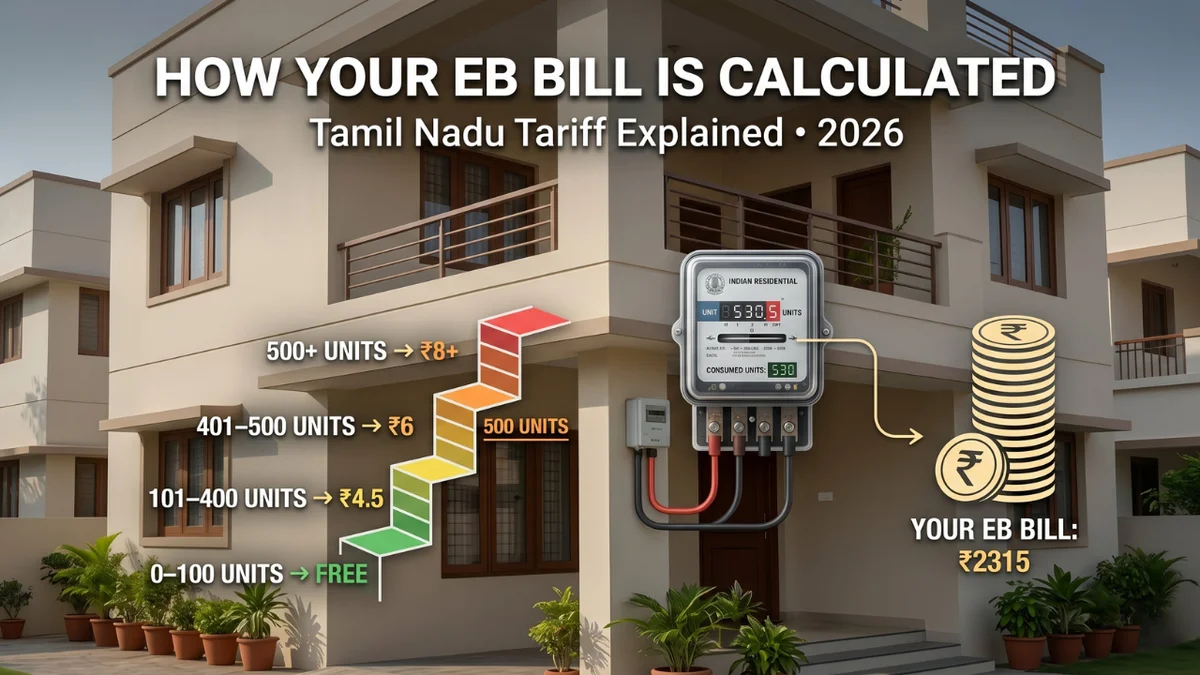
Here are the official TNEB domestic tariff slabs (approximate rates as of recent revisions for residential homes, billed bi-monthly):
Scenario A: If total consumption is UP TO 500 Units:
- 0 to 100 Units: ₹0.00 (Free)
- 101 to 400 Units: ₹4.50 per unit
- 401 to 500 Units: ₹6.00 per unit
Scenario B: If total consumption crosses 500 Units (501 Units and above):
- 0 to 100 Units: ₹0.00 (Free)
- 101 to 400 Units: ₹4.50 per unit (Subsidy heavily reduced)
- 401 to 500 Units: ₹6.00 per unit
- 501 to 600 Units: ₹8.00 per unit
- 601 to 800 Units: ₹9.00 per unit
- 801 to 1000 Units: ₹10.00 per unit
- Above 1000 Units: ₹11.00 per unit
Note: In addition to these per-unit charges, TNEB adds Fixed Charges (usually ₹100 or ₹150 based on connected load) and minor surcharges/taxes.
2. Calculation Example 1: The "Safe Zone" (350 Units)
Let's assume it is the winter season. You run fans and a refrigerator, but no heavy Air Conditioning. Your bi-monthly consumption is 350 Units.
Because 350 is strictly under the 500-unit threshold, we use the heavily subsidized Scenario A slabs.
Step 1: The Free Slab (0 - 100)
- The first 100 units are totally free.
- 100 units × ₹0.00 = ₹0
- Remaining units to calculate: 350 - 100 = 250 units.
Step 2: The Second Slab (101 - 400)
- The remaining 250 units fall completely into the ₹4.50 slab.
- 250 units × ₹4.50 = ₹1,125
Final Math:
- Total Unit Charges: ₹0 + ₹1,125 = ₹1,125.
- Add Fixed Charge: ~₹100
- Total EB Bill: ₹1,225.
You consumed a respectable 350 units and paid a very affordable ₹1,225.
3. Calculation Example 2: The "Danger Zone" (480 Units)
It is early summer. You start running one AC for a few hours a night. Your bi-monthly consumption rises to 480 Units.
You are still strictly under the 500-unit cliff, so we continue using Scenario A.
Step 1: The Free Slab (0 - 100)
- 100 units × ₹0.00 = ₹0
- Remaining units to calculate: 480 - 100 = 380 units.
Step 2: The Second Slab (101 - 400)
- This slab maxes out at 300 units (from 101 up to 400).
- 300 units × ₹4.50 = ₹1,350
- Remaining units to calculate: 380 - 300 = 80 units.
Step 3: The Third Slab (401 - 500)
- The remaining 80 units fall into the ₹6.00 slab.
- 80 units × ₹6.00 = ₹480
Final Math:
- Total Unit Charges: ₹0 + ₹1,350 + ₹480 = ₹1,830.
- Add Fixed Charge: ~₹100
- Total EB Bill: ₹1,930.
This is the absolute maximum limit of the subsidized "safe zone."
4. Calculation Example 3: Falling Off the Cliff (750 Units)
It is peak May. You run two Air Conditioners all night. Your bi-monthly consumption spikes to 750 Units.
Because you crossed the 500-unit threshold, you lose the deep subsidies. We must now use the punishing Scenario B slabs.
Step 1: The Free Slab (0 - 100)
- 100 units × ₹0.00 = ₹0
- Remaining units: 750 - 100 = 650 units.
Step 2: The Second Slab (101 - 400)
- This slab maxes out at 300 units.
- 300 units × ₹4.50 = ₹1,350
- Remaining units: 650 - 300 = 350 units.
Step 3: The Third Slab (401 - 500)
- This slab maxes out at 100 units.
- 100 units × ₹6.00 = ₹600
- Remaining units: 350 - 100 = 250 units.
Step 4: The Fourth Slab (501 - 600)
- This slab maxes out at 100 units.
- 100 units × ₹8.00 = ₹800
- Remaining units: 250 - 100 = 150 units.
Step 5: The Fifth Slab (601 - 800)
- The remaining 150 units fall into the brutal ₹9.00 slab.
- 150 units × ₹9.00 = ₹1,350
Final Math:
- Total Unit Charges: ₹0 + ₹1,350 + ₹600 + ₹800 + ₹1,350 = ₹4,100.
- Add Fixed Charge: ~₹150
- Total EB Bill: ₹4,250.
The Harsh Reality Check:
- In Example 2, you used 480 units and paid ₹1,930.
- In Example 3, you used 750 units and paid ₹4,250.
- You only used roughly 50% more electricity, but your bill increased by a staggering 120%. This is why TNEB bills feel so brutally unfair during the summer.
5. How to Escape the Telescopic Tariff Trap
If you regularly calculate your bill and find yourself trapped in the 600, 800, or 1000+ unit slabs, behavioral changes (like turning off lights or buying 5-star ACs) will no longer save you.
The mathematical reality is that you must generate your own electricity to push your "Net Billed Units" back down the telescopic ladder. The only way to achieve this is through a Grid-Tied Rooftop Solar System.
The Solar Math Example:
Assume you are stuck at the 750-unit consumption level (a ₹4,250 bill).
You install a highly subsidized 3kW On-Grid Solar System on your roof in Cuddalore.
- This 3kW system will generate approximately 15 units a day in the sun.
- Over a 60-day bi-monthly billing cycle, it generates 900 units.
- Through TNEB's official "Net Metering" policy, these 900 solar units are directly subtracted from your total house consumption.
The New TNEB Calculation:
- House Consumption: 750 Units
- Solar Generation: 900 Units
- Net Billed Units: -150 Units.
You owe TNEB absolutely nothing for electricity usage. Furthermore, those 150 surplus units are banked in your TNEB account to be used during the rainy monsoon season. Your ₹4,250 bill permanently drops to just the ₹150 fixed meter charge.
Financial Breakdown: Calculating Your Solar ROI
Technical Sizing Based on Bill Analysis
- Bill Audit Formula: Current bill amount / Average unit rate = Units consumed
- Solar Offset Calculation: Required solar kW = (Units consumed / 30 days) / 4 hours peak sun
- Net Metering Efficiency: 95-98% credit utilization (minimal losses)
Financial Breakdown: The Tariff Escape Plan
- Current High Bill Example: ₹4,250 for 750 units
- 3kW Solar System Cost: ₹1,80,000
- PM Surya Ghar Subsidy: ₹78,000
- Net Investment: ₹1,02,000
- New Bill (After Solar): ₹150 fixed charges only
- Monthly Savings: ₹4,100
- Payback Period: 2.5 years
- 20-Year Savings: ₹9,84,000 (After payback)
Advanced Financial Modeling
- Escalating Tariff Protection: Solar locks in current rates vs TNEB's annual increases
- Inflation Hedge: Electricity costs rise 8-10% annually; solar is fixed
- Asset Appreciation: Home value increases by 5-8% with solar installation
Mathematical Guarantee: Solar doesn't just reduce bills; it mathematically eliminates the penalty slabs entirely. Your consumption stays subsidized while credits keep you free.
Conclusion
Understanding TNEB tariff calculation empowers you to stop guessing and start planning. By identifying exactly which high-penalty slab your household falls into, you can determine exactly how much money you are losing to the grid every two months.
With the massive financial incentives offered under the central government's PM Surya Ghar Subsidy scheme (up to ₹78,000 direct subsidy), investing in a rooftop solar system is mathematically the smartest, highest-yielding financial decision a homeowner in Tamil Nadu can make to defeat the telescopic tariff trap permanently.
Are you tired of doing the math on massive EB bills? Contact the engineering team at Surya's Solar today for a free roof assessment. We will analyze your past EB bills and design a custom solar plant that permanently drops your net consumption into the Free Slab.
Tags
Ready to Switch to Solar?
Get a customized solar solution for your home. Save up to 90% on electricity bills!
- Free Site Visit
- Govt. Subsidy Support
- 25 Years Warranty