
How Much Solar Is Needed for a ₹3000–₹5000 Electricity Bill in Tamil Nadu? (2026 Guide)
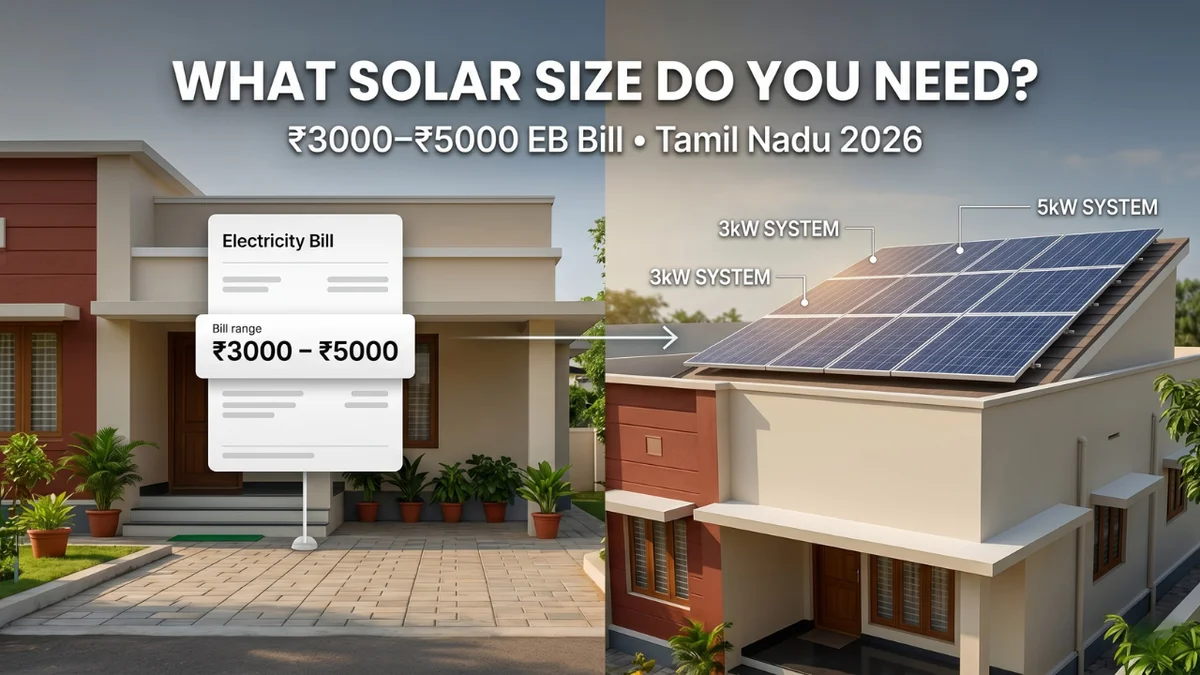
If you are reading this, there is a very strong chance you recently opened your bi-monthly TNEB electricity bill and felt a wave of frustration when you saw a figure between ₹3,000 and ₹5,000. You are not alone.
In Tamil Nadu—especially in cities like Cuddalore, Puducherry, Panruti, and Neyveli—summer electricity bills between ₹3,000 and ₹8,000 are now the norm for middle-class households running air conditioners. And the pain is only going to get worse as TNEB tariffs continue to rise annually.
But here is the good news: a high electricity bill actually tells us precisely how much solar power you need. Your bill is essentially a road map. In this detailed engineering guide, we will reverse-engineer your ₹3,000 to ₹5,000 bill to calculate the exact solar system size that will eliminate it permanently.
1. First: Understanding What a ₹3,000–₹5,000 Bill Actually Means
Before we can size a solar system, we must understand what consumption level a ₹3,000 to ₹5,000 bill represents. We covered the TNEB telescopic tariff slabs in detail in our earlier guide, but here is a quick reference for our calculations.
The TNEB bills you on a bi-monthly (every two months) cycle.
A ₹3,000 bill typically means you have consumed somewhere between 550 and 650 units bi-monthly. You have crossed the punishing 500-unit cliff, and your units are now being billed at ₹8.00 per unit.
A ₹5,000 bill typically means you have consumed somewhere between 700 and 850 units bi-monthly. You are now firmly stuck in the ₹9.00 per unit slab.
This is a household that runs:
- 1 or 2 Air Conditioners (1.5-ton each) for 6 to 10 hours every night
- A double-door refrigerator running 24/7
- 4 to 6 ceiling fans
- A washing machine
- LED lights throughout the home
- Occasionally a water pump or geyser
2. The Core Calculation: How Much Solar Do You Need?
The fundamental goal of a grid-tied solar system is simple: Generate at least as many units over the two-month billing cycle as you consume from the grid.
If your net consumption is 700 units bi-monthly, your solar system must generate at least 700 units over those same 60 days.
Step 1: Calculate Required Daily Generation
700 units over 60 days = 11.67 units per day that your solar system needs to produce.
Step 2: Calculate Required System Size
In Tamil Nadu, a well-installed, shadow-free solar system generates approximately 4 to 5 units per kW of installed capacity per day (this accounts for real-world efficiency losses from inverter conversion, cable resistance, and temperature derating).
Using the conservative 4-unit-per-kW figure:
- Required generation: 11.67 units/day
- ÷ 4 units per kW per day
- = 2.9 kW of solar capacity needed
This rounds up perfectly to a standard 3kW On-Grid Solar System.
3. The 3kW vs. 5kW Decision Framework
If your bill falls between ₹3,000 and ₹5,000, you are almost certainly looking at either a 3kW or a 5kW system. Here is the honest framework to help you decide:
Choose a 3kW System If:
- Your bi-monthly consumption is consistently under 700 units (bill under ₹4,000)
- You run only one 1.5-ton Air Conditioner
- You do not plan to add more ACs in the next 5 years
- You have limited roof space (a 3kW system needs roughly 250–300 sq. ft.)
A 3kW system generates approximately 12 to 15 units per day, producing 720 to 900 units over a 60-day billing cycle. This is more than enough to offset a 600–700 unit bi-monthly consumption.
Choose a 5kW System If:
- Your bi-monthly consumption is between 700 and 1,000 units (bill ₹4,000–₹7,000)
- You currently run two ACs, or plan to add a second AC within 3 years
- You have adequate roof space (a 5kW system needs roughly 450–500 sq. ft.)
- You want a larger buffer to ensure your net bill stays at zero even during peak summer
A 5kW system generates approximately 20 to 25 units per day, producing 1,200 to 1,500 units over a 60-day cycle. This comfortably crushes even a heavily AC-loaded 1,000-unit bi-monthly bill.
4. The Net Metering Mechanism: How You Actually Save
Many homeowners are confused about how a solar system eliminates a bill when the sun shines during the day, but your AC runs at night. This is where Net Metering comes in.
An On-Grid solar system is synchronized with the TNEB utility grid. During the day:
- Your solar panels generate power. The home uses what it needs (fridge, fans, TV).
- The surplus power that you are not using at that moment is pushed out of your house and into the TNEB street grid. A bi-directional Net Meter on your wall counts every unit you export.
During the night:
- Your solar panels are off. You pull power from the TNEB grid to run your ACs.
- The Net Meter counts every unit you import.
At the end of the two-month billing cycle, TNEB calculates: [Units Imported] MINUS [Units Exported] = Net Consumption. If your solar panels exported more units than you imported at night, your final bill is minimal or zero.
This is why you do not need batteries. The TNEB grid itself acts as your free storage system.
5. Real-World Case Study: A 3 BHK Home in Cuddalore
Let us look at a real-world style example. A family in Cuddalore runs:
- One 1.5-ton 5-star inverter AC (8 hours/night) = ~5 units/night
- Fridge (24/7) = ~2.5 units/day
- 3 fans (10 hours/day) = ~1 unit/day
- TV, lights, chargers = ~1.5 units/day
- Total Daily House Consumption: ~10 units/day
- Bi-Monthly Consumption: ~600 units
Before solar, their TNEB bill crossed the 500-unit cliff and was consistently around ₹3,800 bi-monthly (₹22,800 per year).
After installing a 3kW On-Grid system:
- System generates ~14 units/day in Cuddalore = 840 units over 60 days
- House consumed 600 units. Solar generated 840 units.
- Net export to grid: 240 surplus units banked for the monsoon season.
- New bi-monthly TNEB bill: ₹100 to ₹150 (fixed meter charges only).
- Annual savings: approximately ₹22,200 per year.
With a 3kW system priced at around ₹1,80,000 and a PM Surya Ghar subsidy of ₹78,000, the net cost to the family was ₹1,02,000. Payback period: under 5 years. After that, 20+ years of free electricity.
6. The PM Surya Ghar Subsidy: The Financial Booster
For a household with a ₹3,000 to ₹5,000 bi-monthly bill, the economics of solar in 2026 are genuinely compelling, largely because of the central government's PM Surya Ghar Muft Bijli Yojana.
- For a 3kW System: You receive a direct bank transfer of ₹78,000 (the maximum subsidy amount).
- For a 5kW System: You also receive a subsidy (the exact amount depends on state co-funding and component specifications).
This subsidy is deposited directly into your bank account within 30 to 90 days of your system being commissioned and your TNEB net meter being installed and activated.
Important: To receive the subsidy, your installation must be done through a registered PM Surya Ghar empanelled vendor. Always ask your installer for their MNRE empanelment certificate before signing any agreement.
7. Honest Limitations: What Solar Cannot Do
We believe in giving you the full, unvarnished truth.
- Solar cannot give you backup during TNEB power cuts. If you want to run your AC during a power cut, you need a significantly more expensive Hybrid system with batteries. On-Grid systems mandatorily shut down when the grid fails (Anti-Islanding safety law).
- Solar generation varies seasonally. Your panels will generate maximum power in April–June (peak summer) and less power in July–September (monsoon). Your net-metering account will bank large surpluses in summer to cover the deficit in monsoon months.
- Shading is the enemy of solar. If even one panel has 20% shade, it can reduce the output of your entire string by a significant amount. A proper site survey is mandatory before installation.
Financial Breakdown: ₹5,000 Bill Solutions
Technical Sizing for High Bills
- Bill Analysis: ₹5,000 bill = ~400-500 units bi-monthly
- Solar Requirement: 3-5kW system for full offset
- Net Metering Setup: Essential for credit banking
Financial Breakdown: High Bill ROI
- Current Annual Cost: ₹30,000 (₹5,000 x 6)
- 5kW Solar System: ₹2,80,000
- Subsidy: ₹78,000 (scaled for 5kW)
- Net Cost: ₹2,02,000
- Annual Savings: ₹30,000
- Payback Period: 6.7 years
- Long-term Value: 18+ years free electricity
Advanced Financial Planning
- Loan Options: EMI ₹4,000-₹5,000/month
- Cash Flow: Positive after 1-2 years with loans
- Inflation Protection: Locks in current electricity rates
Key Insight: High bills mean high savings potential; solar scales perfectly with consumption.
Conclusion: Your ₹3,000–₹5,000 Bill Has a Clear Mathematical Answer
The answer is a 3kW On-Grid Solar System, and it is genuinely the best financial investment available to a middle-class household in Tamil Nadu today.
Are you ready to permanently eliminate your heavy TNEB bill? Contact the engineering team at Surya's Solar for a free site visit and exact system design calculation tailored to your specific bi-monthly bill history.
Tags
Ready to Switch to Solar?
Get a customized solar solution for your home. Save up to 90% on electricity bills!
- Free Site Visit
- Govt. Subsidy Support
- 25 Years Warranty