
How Much Solar Do You Need for Your Home in India? (2026 Complete Sizing Guide)
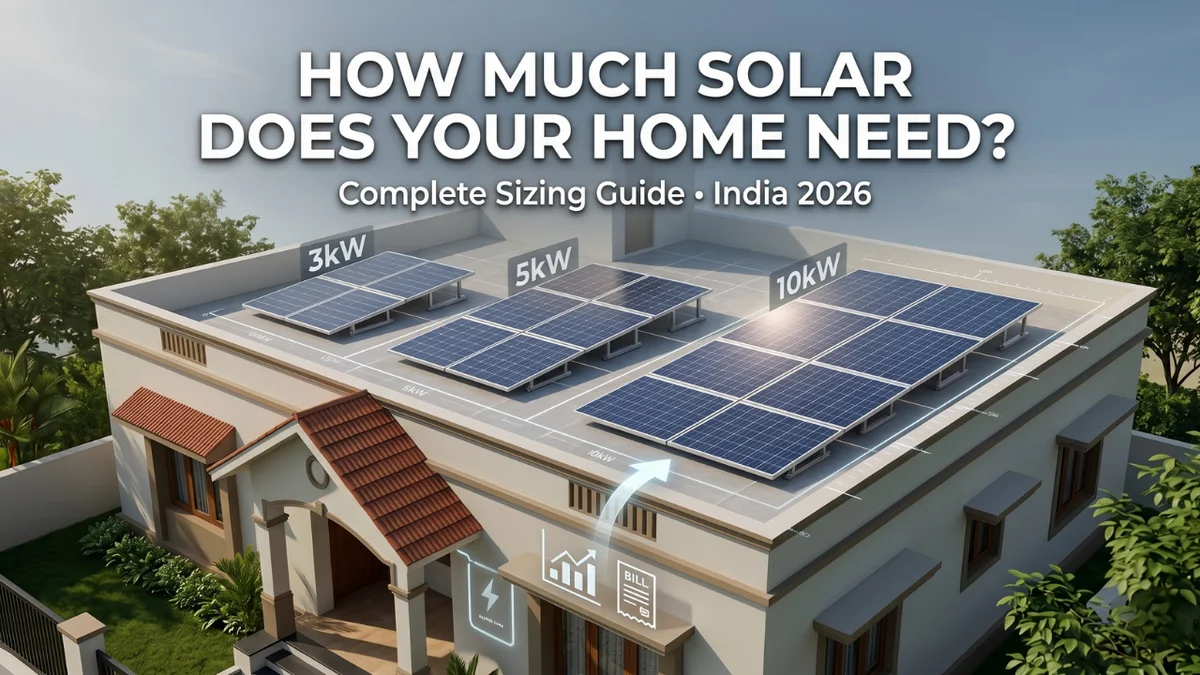
"How much solar do I need for my home?" is the single most important question in all of residential solar power. Get the sizing right and you enjoy zero electricity bills for 25 years. Get it wrong—by going too small—and you are still stuck paying TNEB thousands of rupees every two months despite having expensive panels on your roof.
Sizing a solar system is not guesswork. It is a precise engineering discipline based on your actual electricity consumption, your roof's geographic orientation, the local solar irradiation levels, and the technical efficiency of the system components you choose.
In this definitive engineering guide, we provide the complete, step-by-step methodology to calculate exactly how much solar power your home in India needs.
1. The Golden Starting Point: Your Electricity Bill
The most reliable and accurate data source for sizing your solar system is not a generic online calculator. It is your own past TNEB (or BESCOM, MSEDCL, or your state electricity board) electricity bills.
Pull out your last 4 to 6 bi-monthly bills (covering a full year). Find the "Units Consumed" figure on each bill. This gives you a complete picture of your seasonal consumption pattern.
For example, a household might consume:
- Jan–Feb: 380 units (mild winter, no AC)
- Mar–Apr: 550 units (warming up, AC starting)
- May–Jun: 900 units (peak summer, AC running all night)
- Jul–Aug: 700 units (hot and humid, moderate AC)
- Sep–Oct: 500 units (post-monsoon)
- Nov–Dec: 350 units (cool, fans only)
- Annual Total: ~3,380 units
Now calculate your average bi-monthly consumption: 3,380 ÷ 6 = 563 units per bi-monthly cycle.
This is the single number that drives your solar system sizing.
2. The Core Sizing Formula
Solar system sizing is based on a very simple engineering equation:
Required kW = Daily Unit Requirement ÷ Peak Sun Hours
Let us break this down:
Step 1: Convert bi-monthly consumption to daily.
- 563 units per 60 days = 9.38 units required per day.
Step 2: Determine your location's Peak Sun Hours (PSH). Peak Sun Hours are not the same as "hours of sunlight." They represent the equivalent number of hours per day where the sun's intensity is exactly 1,000 Watts per square meter (standard test conditions for panels). This is determined by your geography.
- Tamil Nadu (Cuddalore, Puducherry, Panruti): 4.5 to 5.2 PSH per day
- Maharashtra, Karnataka: 4.8 to 5.5 PSH per day
- Rajasthan, Gujarat: 5.5 to 6.5 PSH per day (highest in India)
- West Bengal, Northeast India: 3.5 to 4.2 PSH per day (lowest)
For Tamil Nadu, we will use a conservative 4.5 PSH for our calculation.
Step 3: Apply a real-world efficiency factor (Performance Ratio).
No solar system in the real world operates at 100% efficiency. After accounting for inverter losses (3%), cable losses (2%), temperature derating (4%), and dust (3%), a typical Indian installation operates at a Performance Ratio (PR) of around 0.75 to 0.80.
We will use 0.78 for our calculation.
Step 4: The complete formula.
- Required kW = Daily Units ÷ (PSH × PR)
- Required kW = 9.38 ÷ (4.5 × 0.78)
- Required kW = 9.38 ÷ 3.51
- Required kW = 2.67 kW → Round up to 3kW.
3. Quick Reference: India Home Solar Sizing Table
For those who prefer a direct reference, our engineering team has compiled the following table. It covers most standard Indian household consumption profiles and accounts for Tamil Nadu's specific solar irradiation levels.
| Monthly EB Bill (Approx.) | Bi-Monthly Units | Recommended System | Daily Generation | Annual Savings |
|---|---|---|---|---|
| ₹500 – ₹1,000 | 150 – 250 Units | 1kW On-Grid | ~4-5 Units | ₹5,000 – ₹8,000 |
| ₹1,500 – ₹2,500 | 350 – 450 Units | 2kW On-Grid | ~9-10 Units | ₹12,000 – ₹18,000 |
| ₹3,000 – ₹5,000 | 550 – 750 Units | 3kW On-Grid | ~13-15 Units | ₹22,000 – ₹30,000 |
| ₹5,000 – ₹8,000 | 800 – 1,100 Units | 5kW On-Grid | ~20-25 Units | ₹35,000 – ₹50,000 |
| ₹8,000+ | 1,100+ Units | 7.5kW or 10kW | ~35-50 Units | ₹60,000+ |
4. The 5 Real-World Variables That Affect Your System Size
The formula above gives you a theoretical starting point. But in the real world, five additional variables can significantly push the required system size up or down.
Variable 1: AC Tonnage and Technology
This is the single biggest load in any modern Indian home. A 2-ton non-inverter AC running 8 hours a day can push your daily consumption from 10 units to 18 units in peak summer, requiring a 5kW system instead of a 3kW system. Before sizing your solar plant, always check what type and how many ACs you have.
Variable 2: Roof Orientation and Tilt Angle
South-facing roofs (facing the sun throughout the day) in India receive the maximum solar radiation. East or West-facing panels will typically produce 15% to 20% less power. If your roof is north-facing, solar may not be cost-effective for you. A proper site survey by a qualified engineer is essential.
Variable 3: Shading from Nearby Trees and Buildings
Shading is the most destructive force in a solar installation. If a single panel in a 3kW string is 50% shaded by a neighbouring building's shadow at 2 PM, it can reduce the output of the entire system by 30% to 50% depending on the inverter technology used. Always request a shade analysis as part of your site survey.
Variable 4: Future Load Growth
Your electricity consumption will likely increase over the next 5 to 10 years. You may add a second AC, buy an Electric Vehicle (EV) that needs charging, or run a water purifier. When sizing your system, our engineers always recommend adding a 20% buffer to your current requirement to accommodate future load growth without needing to expand the system later.
Variable 5: Panel Degradation Over Time
Even the best Tier-1 solar panels lose approximately 0.5% to 0.7% of their output each year due to natural chemical degradation. This is called the "annual degradation rate." A 3kW system generating 15 units/day today will generate approximately 11.25 units/day after 25 years. A properly designed system should account for this by slightly over-sizing the array from day one.
5. On-Grid vs. Hybrid: Which System Type for Your Home?
Now that you know what size, you must choose the type of system. This decision dramatically changes the cost and the benefits.
On-Grid System (Recommended for 90% of homeowners):
- Directly synchronized with the TNEB grid.
- No batteries required. Lower upfront cost.
- Eligible for the PM Surya Ghar subsidy.
- Does NOT provide backup during power cuts.
- Best suited for: Urban and semi-urban areas with reliable TNEB supply.
Hybrid System (For areas with frequent power cuts):
- Includes battery storage (Lithium-ion or Lead-Acid).
- Provides backup power during TNEB failures.
- Significantly higher upfront cost (batteries alone can add ₹80,000 to ₹2,00,000 to the budget).
- Best suited for: Rural areas, coastal zones prone to cyclone-related cuts, and businesses requiring uninterrupted power.
6. The Honest Truth About Roof Space
Before you commit to any system size, you must ensure your roof can physically accommodate the panels.
As a general rule:
- 1kW of panels requires approximately 80 to 100 sq. ft. of clear, shadow-free roof space.
- A 3kW system (9 to 10 panels) needs approximately 270 to 300 sq. ft. (roughly the size of a standard 2-car parking area on your terrace).
- A 5kW system (15 to 17 panels) needs approximately 450 to 510 sq. ft.
If your available shadow-free terrace is smaller than required, you can compensate slightly by using higher-wattage panels (e.g., 545W or 600W Tier-1 panels instead of standard 400W panels). This is a common engineering solution for space-constrained rooftops in dense urban areas like Cuddalore town and Puducherry city limits.
Financial Breakdown: Sizing for Maximum ROI
Technical Sizing Methodology
- Load Analysis: Peak demand + 20% safety margin
- Generation Calculation: kW x 4-5 hours sun x 30 days = Monthly units
- Efficiency Factors: 80% system efficiency, 85% net metering credit
Financial Breakdown: Cost vs. Benefits
- 1kW System: ₹60,000 - ₹70,000 (Small home backup)
- 3kW System: ₹1,80,000 (₹1,02,000 after subsidy) - Most homes
- 5kW System: ₹2,80,000 (₹2,02,000 after subsidy) - Large homes/AC
- Payback Period: 3-5 years depending on bill size
- 25-Year Savings: ₹3,00,000 - ₹6,00,000
Advanced Sizing Considerations
- Future Load Growth: Size for 5-10 years ahead
- Battery Integration: Adds reliability but increases cost
- Modular Expansion: Start small, expand later
Engineering Principle: Oversizing by 20% costs less than undersizing by 10%.
Conclusion: Sizing Your Solar System is an Engineering Science
Never trust a vendor who gives you a system recommendation without thoroughly analysing your past electricity bills, conducting a roof measurement, performing a shade analysis, and accounting for future load growth.
A properly sized system is the difference between a zero electricity bill and one that still stings every two months.
Want a precise, engineering-grade solar system size calculated for your specific home? Contact the experts at Surya's Solar today for a completely free, zero-obligation site feasibility assessment.
Tags
Ready to Switch to Solar?
Get a customized solar solution for your home. Save up to 90% on electricity bills!
- Free Site Visit
- Govt. Subsidy Support
- 25 Years Warranty