
How Much Can You Save With Solar Panels in India? (Real Numbers, 2026)
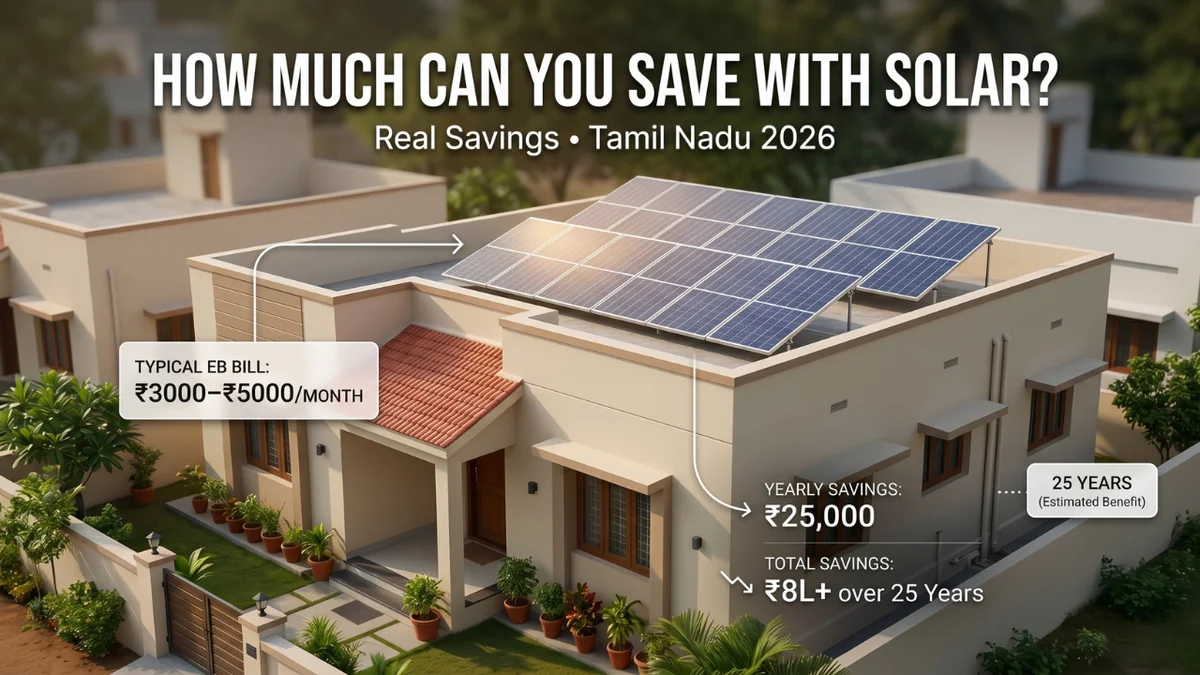
The most important question anyone asks before signing a solar installation agreement is: "How much money will I actually save?"
Unfortunately, this is also the question most riddled with misleading marketing. You have likely seen claims like "Save 90% on electricity bills!" or "Free electricity for 25 years!" plastered on banners. While these are technically possible in ideal scenarios, they paint an unrealistically rosy picture.
At Surya's Solar, we believe in giving you the authentic, unvarnished financial truth. In this comprehensive guide, we break down exactly how much money a homeowner in Tamil Nadu (and broader India) can realistically expect to save on solar, based on real system performance data and actual TNEB billing mathematics.
1. Why Savings Vary So Dramatically Between Households
Before we present any numbers, you must understand that solar savings are not a flat figure. Your specific savings depend on four critical variables that are unique to your situation:
- Your Current Electricity Consumption: The more you consume—and specifically, the higher your TNEB tariff slab—the more you save. A household stuck in the ₹9.00/unit slab saves far more per unit than one comfortably in the ₹4.50/unit slab.
- Your Solar System Size: Larger systems generate more units and eliminate more bill value. A 5kW system saves more than a 1kW system.
- Your Roof's Solar Potential: A south-facing, shadow-free roof in Cuddalore will generate more power than a partially shaded, west-facing roof in Mumbai.
- Future Electricity Tariff Increases: TNEB tariffs have historically increased by 3% to 5% per year. The savings from your solar panels automatically grow in value every year as TNEB charges more per unit.
2. Monthly and Annual Savings: Household Scenarios
Let us look at three typical Tamil Nadu household profiles to provide realistic, scenario-based savings estimates. All figures are based on actual TNEB tariff slabs, typical Tamil Nadu solar irradiation (4.5 PSH), and standard system performance ratios.
Scenario A: The Moderate User (2kW System)
- Profile: 2 BHK flat, no AC, standard appliances (fridge, washing machine, 3 fans, LED lights, TV).
- Bi-monthly consumption: 280 to 350 units.
- Current bill: ₹800 to ₹1,200 bi-monthly.
- Recommended system: 2kW On-Grid.
- Daily generation: ~9 to 10 units per day.
- Realistic annual savings: ₹7,000 to ₹10,000 per year.
- Payback period: 8 to 11 years (higher than ideal because consumption is already in the cheap slab).
Honest Note: If your current bill is under ₹1,500 bi-monthly, the financial ROI on solar is less compelling. Solar works best for households in the high-penalty tariff slabs.
Scenario B: The Standard AC User (3kW System)
- Profile: 3 BHK house, one 1.5-ton AC, standard appliances.
- Bi-monthly consumption: 550 to 700 units.
- Current bill: ₹3,500 to ₹4,500 bi-monthly (₹21,000 to ₹27,000 annually).
- Recommended system: 3kW On-Grid.
- Daily generation: ~13 to 15 units per day.
- New annual TNEB bill: ₹600 to ₹1,200 (only fixed charges remain).
- Realistic annual savings: ₹19,000 to ₹26,000 per year.
- Net investment (after ₹78,000 subsidy): ~₹1,00,000.
- Payback period: 4 to 5 years. ✅
Scenario C: The Heavy User (5kW System)
- Profile: 4 BHK villa or large home, two 1.5-ton ACs, large appliances.
- Bi-monthly consumption: 900 to 1,200 units.
- Current bill: ₹7,000 to ₹11,000 bi-monthly (₹42,000 to ₹66,000 annually).
- Recommended system: 5kW On-Grid.
- Daily generation: ~20 to 25 units per day.
- New annual TNEB bill: ₹1,200 to ₹2,400 (mostly fixed charges).
- Realistic annual savings: ₹39,000 to ₹63,000 per year.
- Net investment (after applicable subsidies): ~₹1,50,000 to ₹2,00,000.
- Payback period: 3 to 5 years. ✅✅
3. The 25-Year Savings Projection (The Real Wealth Builder)
This is where the mathematics of solar truly becomes breathtaking. Most people focus on the payback period and ignore what happens in the 21+ years after the system has paid for itself.
Let us model Scenario B (the standard 3kW AC user) over 25 years, assuming a conservative 4% annual TNEB tariff increase:
- Year 1: Save ₹23,000 (current tariff rate)
- Year 5: Save ₹27,978 (tariff has risen 4% annually)
- Year 10: Save ₹34,074 (tariffs keep rising, your solar keeps working)
- Year 15: Save ₹41,493 (your solar panels are still under warranty)
- Year 20: Save ₹50,524 (panels still generating at ~90% capacity)
- Year 25: Save ₹61,530 (panels at ~87% capacity, but tariffs are much higher)
Total 25-Year Savings: approximately ₹8.5 to ₹9.5 Lakhs.
For a net investment of ₹1,00,000, this is a 9x return on investment over 25 years. Not even a government bond or fixed deposit can offer this guaranteed, tax-free financial return.
4. The Factors That Can Reduce Your Savings (Honest Assessment)
We never want to oversell solar. Here are the real-world factors that can reduce your actual savings below the projected figures:
Monsoon Season Generation Dip: During the Tamil Nadu northeast monsoon (October to December), prolonged overcast skies and heavy cloud cover can significantly reduce solar generation for 2 to 3 consecutive weeks. Well-designed systems build in surplus capacity from the summer months to compensate, but this is a genuine seasonal variable to be aware of.
TNEB Net Metering Policy Changes: The current Net Metering policy in Tamil Nadu is highly favorable to solar prosumers. However, government policies can change. While wholesale dismantling of existing net metering agreements is unlikely (political backlash), future installations may receive different terms. This is a low-probability but non-zero risk.
Panel Degradation: As mentioned, Tier-1 panels degrade at approximately 0.5% to 0.7% per year. By Year 25, your system generates about 12% to 16% less power than it did on Day 1. This is already factored into our Year 25 projection above, but it is worth understanding.
Inverter Replacement: A solar inverter's typical lifespan is 10 to 15 years. You will likely need to replace the inverter once over the 25-year life of the system. A good quality string inverter for a 3kW system costs approximately ₹15,000 to ₹25,000. This cost should be factored into your 25-year total.
5. Beyond Electricity Savings: The Asset Value
Solar panels are a certified, tangible home asset. An increasing number of property valuers in Tamil Nadu are beginning to factor in the presence of a commissioned rooftop solar system when calculating property resale value.
Studies from mature solar markets like the United States and Australia have demonstrated that homes with grid-tied solar systems sell for 3% to 6% higher than comparable homes without solar. In the Tamil Nadu real estate market, this is still an emerging trend, but in areas like Cuddalore and Puducherry, where electricity costs are high and solar awareness is growing rapidly, a 3kW solar system on your rooftop is increasingly seen as a premium feature—not unlike a modular kitchen or a covered car park.
6. Quick Summary: Are Solar Savings Real?
Yes, absolutely. Solar panel savings are completely real, mathematically verifiable, and guaranteed by the laws of physics and the TNEB billing structure.
The key takeaways for a Tamil Nadu homeowner are:
- If your bi-monthly TNEB bill is above ₹3,000, solar provides genuinely compelling financial returns with a payback period of under 5 years.
- The larger and more expensive your current electricity bill, the faster your solar system pays for itself.
- The PM Surya Ghar subsidy significantly accelerates the payback period by reducing your net investment.
- Savings grow over time as TNEB tariffs rise, making solar more valuable every single year.
Financial Breakdown: Maximizing Your Savings
Technical Optimization for Maximum Savings
- Panel Orientation: South-facing for 15-20% more generation
- Inverter Efficiency: 95%+ for minimal losses
- Net Metering Setup: Zero export limits to avoid penalties
Financial Breakdown: The Complete Savings Calculator
- Average Indian Home Bill: ₹3,000 - ₹5,000/month
- Annual Electricity Cost: ₹36,000 - ₹60,000
- 3kW Solar Investment: ₹1,80,000
- Subsidy Reduction: ₹78,000
- Net Cost: ₹1,02,000
- Annual Savings: ₹36,000 - ₹60,000
- Payback Period: 1.7 - 2.8 years
- 25-Year Total Savings: ₹5,00,000 - ₹8,00,000
Advanced Financial Strategies
- Loan Financing: EMI ₹2,000-₹3,000/month with positive cash flow
- Tax Benefits: Section 80C deductions
- Insurance Coverage: System protection against damage
Pro Tip: Solar savings compound annually as electricity prices rise 8-10% per year.
Conclusion: Your Roof Can Become a 25-Year Savings Engine
The data is unambiguous. For a household in Tamil Nadu with a bi-monthly electricity bill above ₹3,000, investing in a grid-tied rooftop solar system is the single highest-yielding, safest, and most guaranteed financial investment available.
Ready to calculate your specific savings? Contact the engineering team at Surya's Solar today for a free, personalized savings assessment based on your actual TNEB bills.
Tags
Ready to Switch to Solar?
Get a customized solar solution for your home. Save up to 90% on electricity bills!
- Free Site Visit
- Govt. Subsidy Support
- 25 Years Warranty