
Solar Earthing Guide: Why You Need 3 Separate Pits (AC, DC, LA)
"Sir, the other quoter said 1 earthing pit is enough. Why are you quoting for 3?"
This is the most common objection we face. EARTHING is the silent guardian of your solar plant. It protects:
- You and your family from electric shocks.
- The Inverter from voltage surges.
- The House from lightning strikes.
In Cuddalore, where thunder and lightning are common during the Northeast Monsoon (October - December), compromising on Earthing is dangerous. A single lightning strike can fry your Inverter, TV, Fridge, and Wi-Fi router in 0.1 seconds if the earthing path is not separate.
Here is the Gold Standard of Solar Earthing that complies with IS 3043 and IEC 62561 standards.
1. The "3-Pit" Rule Explained
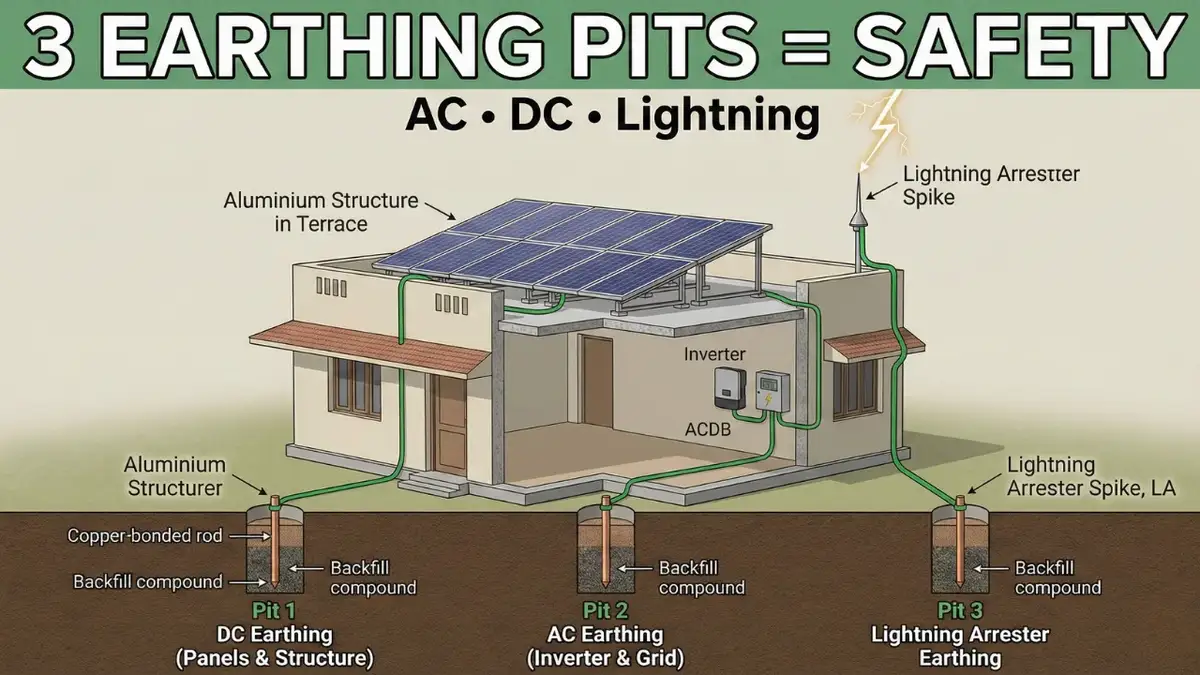
According to IS 3043 (Indian Standards) and TNEB Regulations, a Grid-Connected Solar System MUST have 3 separate Earth Pits. You cannot merge them.
Pit 1: DC Earthing (Structure & Panels)
- What it connects: The aluminium mounting structure and the frames of the solar panels.
- Why: Solar panels generate High Voltage DC (up to 800V). If a wire gets cut by a rat and touches the metal frame, the entire structure becomes "Live". If you touch it, you will get a lethal shock.
- Function: DC Earthing instantly sends this leakage current to the ground, tripping the inverter's Ground Fault Protection Device (GFPD).
Pit 2: AC Earthing (Inverter Body)
- What it connects: The body/heatsink of the Inverter and the Surge Protection Device (SPD) inside the AC Distribution Box (ACDB).
- Why: This handles surges coming from the TNEB Grid side. If a transformer blows up in your street, the surge tries to enter your inverter. AC Earthing blocks it.
Pit 3: LA Earthing (Lightning Arrester)
- What it connects: The Lightning Arrester (Spike) on the top of the roof.
- Why: If lightning strikes near your house, the LA captures the high-voltage surge (millions of volts) and channels it deep into the ground.
- CRITICAL RULE: The LA Pit must be at least 1.5 meters away from the AC/DC pits.
- The Danger: If you merge LA earthing with AC earthing, the lightning current will travel back up the AC wire into your fuse box and explode your appliances.
2. Chemical Earthing vs. Salt & Charcoal
Old Method: Salt & Charcoal (Plate Earthing)
- Process: Dig a hole, put a GI pipe, fill with salt and charcoal layers.
- The Problem: Physics. Salt absorbs water to conduct electricity. In Cuddalore's summer (May/June), the soil dries up completely. The resistance becomes infinite. The Earthing stops working.
- Maintenance: You must water the pit every Sunday. Most homeowners forget.
- Life: 3-4 years (Salt eats the pipe - corrosion).
Modern Method: Maintenance-Free Chemical Earthing
- Process: We use a Copper-Bonded Rod (1 meter or 2 meters long, 250 microns copper coating) and fill the hole with BFC (Back Fill Compound).
- Why BFC? BFC is a moisture-retaining clay. It absorbs humidity from the air and keeps the area around the rod wet 365 days a year. NO WATERING REQUIRED.
- Life: 15-20 years.
At Surya's Solar, we ONLY use Chemical Earthing. We do not use Salt/Charcoal.
3. Resistance Values (The Standard)
After installation, how do you know it works? We stick a measuring device (Earth Tester) into the ground.
- Ideal Resistance: < 2 Ohms.
- Acceptable: < 5 Ohms.
- Fail: > 10 Ohms.
In sandy coastal areas like Devanampattinam, getting low resistance is hard because sand doesn't conduct well.
- Our Solution: We use deeper rods (3 meters) or connect two pits in parallel to lower the resistance.
4. Lightning Arrester (LA): ESE vs Conventional
Conventional Spike (Franklin Rod)
- Range: Protects a cone shape of roughly 45 degrees. Good for small houses.
- Cost: Low.
ESE (Early Streamer Emission)
- Range: Protects a radius (e.g., 30 meters or 60 meters). Used for factories or large villas.
- Mechanism: It sends an upward streamer to catch the lightning before it hits the roof.
For most 2-story homes in Cuddalore, a high-quality Copper Conventional Spike is sufficient.
Concerned About Safety Standards?
Get a free safety audit of your solar installation. We check earthing, wiring, and structural integrity to ensure compliance.
5. Summary Check
When reviewing a quote, check for these line items:
- Earthing Rod: "17mm Copper Bonded Rod (2 meter)" x 3 Nos.
- Compound: "Back Fill Compound (25kg bag)" x 3 Nos.
- Cable: "10 sq.mm or 16 sq.mm Copper Earthing Cable" (Green Color).
- Lightning Arrester: "Copper Spike with Insulator Base".
Safety First. Savings Second.
Frequently Asked Questions
Can I use the same earthing pit for AC and DC?
How do I test if my earthing is working?
What happens if lightning strikes my panels?
Do I need to water earthing pits?
Can earthing pits corrode over time?
Related Articles
- DC Cable Quality - Fire-safe wiring standards
- Maintenance Guide - Regular safety checks
- TNEB Net Meter Guide - TNEB safety certificate process
Get a Free Rooftop Assessment
Our engineers will visit your site, analyze shadow-free area, and provide a detailed solar report.
Book Free AssessmentTags
Ready to Switch to Solar?
Get a customized solar solution for your home. Save up to 90% on electricity bills!
- Free Site Visit
- Govt. Subsidy Support
- 25 Years Warranty